
Top 5 Safari Camera Bags for Bush Planes and Carry-On Travel — 2026 Buyer's Guide
Field-tested across the Serengeti, Kalahari, and Okavango Delta — five bags that survive silicate dust, Cessna floor vibration, and the 15kg weight limits of African bush aviation
Wild by Nature. Africa by Choice.
Your camera bag fails before your first game drive begins. Not because of a faulty zip or a torn strap — but because most photographers arrive in the bush with a bag designed for airport corridors and studio shoots, not for the conditions that actually govern photography in Africa.
In the Serengeti at the height of dry season, the dust is not dust. It is volcanic silicate flour — particles fine enough to bypass standard zip-teeth tolerances and migrate silently into your lens mount, your autofocus motor, and the mirror box of your camera body. In Botswana's Makgadikgadi, that dust turns red and abrasive. In the Okavango, it gives way to humidity and riverine mud. Your bag must perform across all of it.
Then there is the other constraint that retail product pages never mention: the Cessna 208 Caravan and similar six-seat bush aircraft that connect the lodges of Southern and East Africa enforce a strict combined luggage limit of 15 kilograms — camera gear, clothes, and personal effects collectively, often weighed on a handheld scale while you stand on the airstrip. A bag that weighs 3kg empty before a single lens is loaded has already consumed 20% of that allowance.
All five bags evaluated here are assessed against the specific demands of full-frame mirrorless and DSLR systems — Sony FE, Canon RF, and Nikon Z mount — carrying a minimum of one 400mm+ super-telephoto lens and one secondary body. If you are currently researching the camera body to pair with your safari kit, the Canon EOS R5 Mark II vs Nikon Z8 safari comparison delivers the field intelligence on both systems in African conditions.
What is the best safari camera bag for bush planes and carry-on travel?
The Lowepro ProTactic BP 450 AW III is the best safari camera bag for vehicle-based wildlife photography, offering four-point dust-sealed access that allows lens changes without exposing the main compartment to game-drive dust. For bush plane travel specifically, the Peak Design Travel Backpack 45L edges ahead — its compression system allows the bag to shrink to 30L, bypassing strict volume checks on regional aircraft while still accommodating a 600mm f/4 lens when needed.
Explore the Lowepro ProTactic BP 450 AW III on Amazon
Why Your Safari Camera Bag Is Also a Dust and Vibration Management System
The forces working against your gear in the African bush are not dramatic — they are relentless and incremental. Silicate and volcanic dust suspended in dry-season air settles into every gap not specifically sealed against it. The corrugated laterite tracks of Namibia and the rutted game roads of the Serengeti transmit a continuous high-frequency vibration through your vehicle seat and into anything resting on it. During a six-hour game drive, that vibration mimics the mechanical stress of a low-grade continuous impact test.
A well-designed safari camera bag addresses both forces simultaneously: it seals against dust ingress at the zip interface and at the main compartment opening, and it provides sufficient internal padding architecture to absorb vibration across the full length of a super-telephoto lens — not just at the ends.
The critical access variable, however, separates field-serious bags from general travel packs. On a game drive, the moment between a predator appearing and the shot being taken is measured in seconds. A bag that requires you to remove it from your back, set it down on a dusty floor, unzip the main compartment, and root for a lens is a bag that costs you the frame. Top-access and side-access portals that allow targeted extraction without opening the main compartment are not a luxury feature on safari — they are a functional requirement.
What the 15kg Bush Plane Rule Actually Means for Your Camera Gear
Every photographer who has flown into a Southern or East African bush destination on a regional carrier has encountered the weight check. Bush aviation operators — Wilderness Air, Mack Air, Federal Air, and their equivalents — apply a combined luggage limit of 15 kilograms across all bags, carry-on included. Many operators now enforce this with handheld scales at the aircraft door.
The practical arithmetic is unforgiving. A full-frame body with grip: approximately 1.2kg. A 500mm f/4 prime: 3.1kg. A 70-200mm f/2.8: 1.5kg. A second body: 0.8kg. Four batteries, cards, and filters: 0.5kg. That is 7.1kg of glass and electronics before the bag itself is weighed. A bag with a 2.95kg empty weight leaves you 4.9kg for clothing, toiletries, and personal effects across a week-long itinerary.
The bags that survive this arithmetic are either light enough to disappear into the equation, or compressible enough to visually satisfy a volume-focused check. The five recommendations below address both strategies — with honest numbers on each.
The Best Safari Camera Bags for 2026 — Our Field-Tested Shortlist
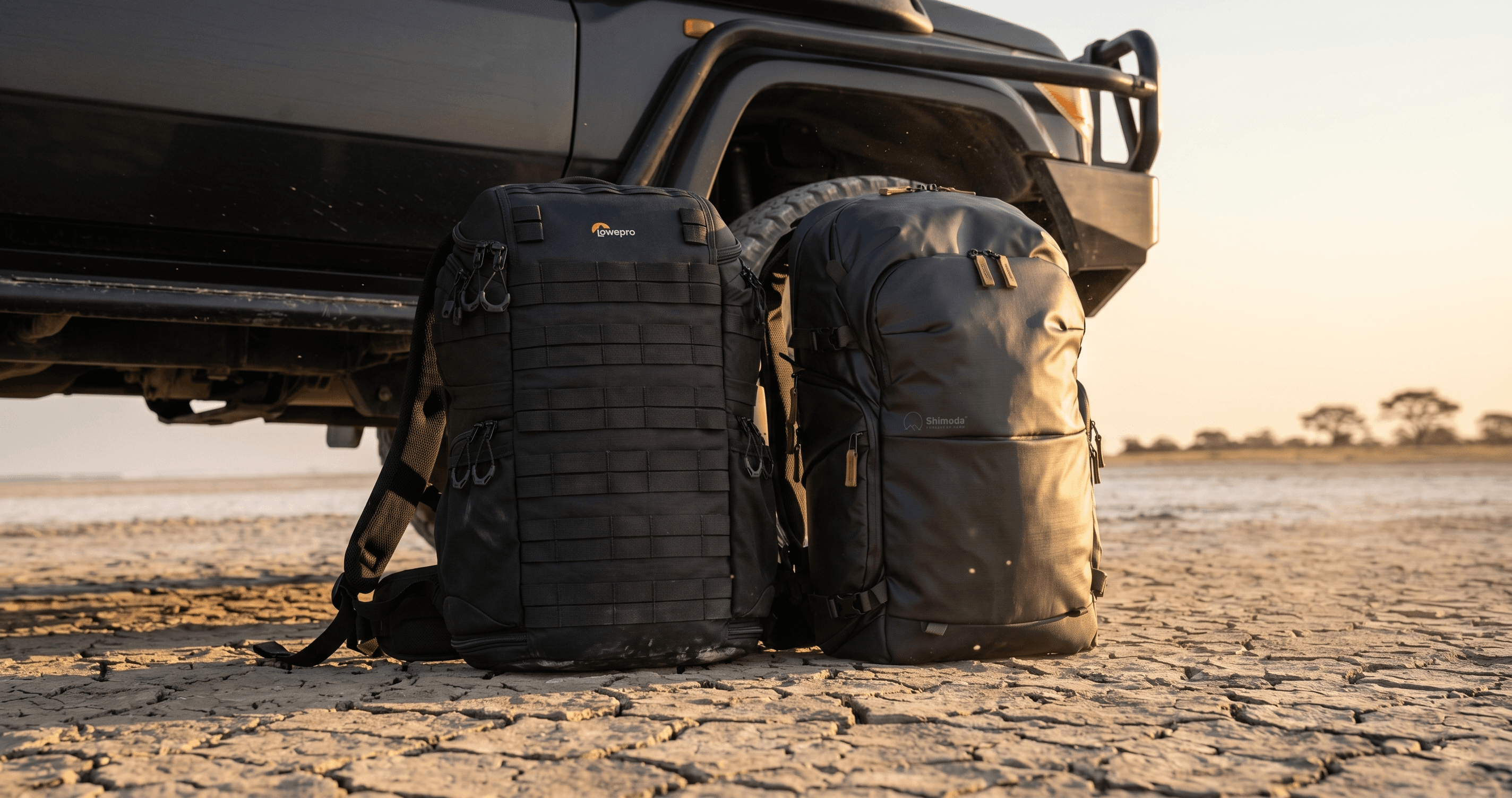
1. Lowepro ProTactic BP 450 AW III — Best for Vehicle-Based Safari Photography
Price range: $280–$310 | External volume: 28L | Empty weight: 2.95kg
The ProTactic 450 AW III is built around one field insight that every other bag in this category underweights: when a cheetah begins a hunt 100 metres from your vehicle on the Serengeti short-grass plains, you do not have time to open your main compartment. You have time to reach over your shoulder and pull a lens through the top-access portal before the action is over.
The four-point access system — top, left side, right side, and rear — is the defining specification of this bag. Each access point is independently dust-sealed with Lowepro's Adaptive FormShell construction, rated to an IPX3-equivalent standard for dust resistance. In practice, this means the right-side portal can be opened to extract or return a 400mm f/5.6 lens while the main compartment, containing the second body and a 70-200mm, remains completely sealed against the rotor-wash dust of a passing vehicle.
The internal architecture accepts a gripped full-frame body with a 500mm prime mounted, plus a secondary body and standard zoom, with a top compartment for accessories. The included rain cover deploys in under ten seconds and wraps the full external surface.
The limitation that matters most on African air travel is the weight. At 2.95kg empty, the ProTactic consumes nearly 20% of the standard 15kg bush-plane allowance before the first piece of glass is loaded. For photographers flying multi-segment itineraries with strict weight enforcement — Maun to Savuti, Kasane to Linyanti — this is a genuine operational constraint that must be planned around, not ignored.
System extension: Lowepro Quick Release Straps allow external mounting of a tripod or monopod up to 1.5kg, freeing internal volume for an additional lens.
Best for the reader who shoots from a stationary vehicle at high-action moments and needs to transition between two focal lengths — from a landscape wide-angle to a tracking telephoto — without taking the bag off their back or exposing the main compartment to game-drive dust.
Order the Lowepro ProTactic BP 450 AW III on Amazon
2. Peak Design Travel Backpack 45L — Best for One-Bag Safari Travel
Price range: $290–$330 | Max capacity: 45L expanded / 35L standard | Dimensions: 53cm x 33cm x 19cm
The single most important thing the Peak Design Travel Backpack 45L does is something no other bag on this list can match: it gets smaller. The compression snap system reduces the bag from a 45L gear hauler to a 30L daypack by pulling in the side panels and collapsing the internal volume around whatever is loaded inside. This is the only mechanism on the market that allows a 45L bag to reliably pass the visual volume check on a 6-seat bush aircraft without checking it as freight.
The shell is 400D weatherproof recycled nylon canvas — not the hardened polymer shell of a Pelican case, and not the generic ripstop of a budget camera backpack, but a structured fabric with enough body to protect a 600mm f/4 in transit while remaining genuinely compressible under operational pressure. Dimensions at standard carry-on configuration — 53cm x 33cm x 19cm — sit within the cabin compliance window of most regional African operators.
The field limitation is weight distribution at full load. The bag lacks a dedicated internal frame. When loaded with a 600mm f/4 (3.1kg), a gripped full-frame body (1.2kg), and a secondary zoom, the mass concentrates in the lower half of the bag without a rigid transfer structure to distribute it across the hip belt. On flat terrain — a boat safari deck, a vehicle roof rack — this is not an issue. On the uneven laterite paths of an Okavango walking excursion, the lower-back fatigue accumulates over a full morning's transit.
System extension: Peak Design Camera Cubes (Large) provide structured internal protection for a 150–600mm zoom while maintaining the soft-shell flexibility required for aircraft pods. The cube system locks position inside the bag and prevents lens movement during vehicle transit.
Best for the reader who flies multiple regional segments in a single trip and needs a single bag that transitions from international cabin baggage to a bush-ready daypack without repacking.
Order the Peak Design Travel Backpack on Amazon
3. Shimoda Explore v2 30 — Best for Gorilla Trekking and Mountain Terrain
Price range: $300–$320 | Carry-on rating: Small plane and EU/Asian airline compliant | Harness system: Height-adjustable, 4 sizes
The Shimoda Explore v2 30 solves a problem that no other bag on this list acknowledges directly: not all safari photographers have the same body. The height-adjustable harness system — four torso-size options, implemented through a sliding back panel rather than aftermarket strap replacement — is the most ergonomically precise fit system available in the field-grade camera bag category.
This matters most in the specific context the Shimoda was designed for: multi-hour trekking over steep, uneven terrain where an ill-fitting bag does not just cause discomfort but actively compromises stability and increases fall risk. Rwanda's Volcanoes National Park involves 3 to 8 hours of mountain trekking at altitude to reach the mountain gorilla habituated groups. Uganda's Bwindi Impenetrable Forest operates on similar terms. A bag that fits the porters and photographers of a diverse trekking group correctly — not approximately — is a genuine field capability differentiator.
The carbonate-coated ripstop nylon shell resists the wet-season mist and mud of highland forest environments in a way that standard water-resistant canvas does not. The harness padding breathes better than the ProTactic at sustained aerobic output, which matters when you are gaining 400 metres of elevation before 8 AM.
The limitation is volume. At 30L, the Explore v2 cannot simultaneously accommodate a gripped full-frame DSLR and a 600mm prime. The bag is sized for a mirrorless body with a 150–600mm zoom and one additional prime — and that is its correct deployment context. Attempting to overload it defeats the weight-distribution engineering.
System extension: Shimoda Women's Specific Straps replace the standard harness with a contoured design for improved weight distribution on longer trekking days — available separately and directly compatible with all Explore v2 versions.
Best for the reader heading to Rwanda or Uganda for gorilla or chimpanzee trekking, where pack comfort, harness fit, and weight distribution over an 8-hour mountain day govern the choice, not access speed or maximum volume.
Order the Shimoda Explore v2 on Amazon
4. PGYTECH OneMo 2 (35L–45L) — Best for Hybrid Video and Stills Operators
Price range: $220–$260 | Main volume: 35L–45L via 10L V-shape expansion | Included accessory: Integrated 7L sling bag
The PGYTECH OneMo 2 makes a commercial argument that the other four bags on this list do not attempt: it is effectively two bags for the price of one. The included 7L shoulder sling detaches from the main body and functions as a standalone pack for essential-only excursions — a second body with a 24–105mm, a SanDisk card wallet, and a water bottle — while the main rig stays locked in the Land Cruiser with the heavy telephoto glass.
For the photographer who is also a hybrid shooter — stills on the game drive, video on the river — the 10L V-shape front expansion accommodates a DJI RS4 gimbal or a folded compact drone alongside the camera system. If you are incorporating aerial footage into your African assignment, this is the only bag on the list that creates internal space for both platforms without forcing you to carry a separate equipment case. For the full aerial photography picture, the best compact drones for safari wildlife photography guide covers the DJI Air 3S and Mini 5 Pro in the specific context of African airspace regulations.
The field limitation is structural. The V-shape expansion, when fully deployed, shifts the bag's centre of gravity forward and creates an imbalance that causes the bag to tip forward when set down on the sandy floor of a safari vehicle or on the loose substrate of a bush airstrip. For a bag used primarily inside a vehicle or lodge, this is a manageable inconvenience. For a bag being walked through uneven terrain, it is a meaningful design compromise.
The high-performance splash-proof PU-coated fabric handles light rain and moisture adequately but does not perform at the dust-sealing level of the Lowepro's FormShell construction. For dry-season Kalahari or Serengeti deployment, a dust cover over the main compartment is recommended.
System extension: PGYTECH CreateMate High-Speed Card Reader Case integrates into the side pockets and enables field-based data redundancy — immediate dual-card backup from a single device without accessing the main camera compartment.
Best for the reader who is a hybrid video and stills shooter requiring internal space for a DJI RS4 gimbal alongside a full mirrorless camera system, and who wants the option of a standalone sling for camp and lodge excursions without repacking.
Order the PGYTECH OneMo 2 on Amazon
5. Lowepro Flipside BP 400 AW III — Best Budget and Transit-Safe Option
Price range: $160–$190 | Empty weight: 1.7kg | Access type: Full rear-entry, CradleFit 15" laptop sleeve
At 1.7kg empty, the Flipside BP 400 AW III is the lightest bag on this list — and that fact matters more on an African bush flight than any other single specification. In the 15kg weight arithmetic, the Flipside saves you 1.25kg compared to the ProTactic. Over a five-destination fly-in itinerary, that is the difference between packing a second set of field clothes and checking luggage.
The rear-entry design delivers a secondary field benefit that is rarely discussed in reviews: the harness — the panel that contacts your back — never touches the ground. When you set the bag down on a dusty game-drive track or a bush airstrip, the zippered access panel faces upward. The surface that returns to contact your clothing and spine never encounters the Kalahari red dust, the volcanic grit of the Ngorongoro rim road, or the thorn-littered ground of a mopane woodland. For transit through multiple destinations, this is a hygiene and comfort advantage that accumulates across a two-week itinerary.
The honest limitation is the one that governs the bag's ranking: there is no top or side access. Changing lenses requires removing the bag entirely, setting it down, and unzipping the rear panel. During active game situations — a leopard descending a tree, a hunting wild dog pack at speed — this is not a viable workflow. The Flipside is a transit bag and a lodge base-camp bag. It is the correct choice for the journey to the bush. It is not the correct primary shooting bag once you are there.
System extension: Lowepro Lens Case 11 x 26cm attaches externally via SlipLock webbing and provides a quick-access housing for a secondary 70-200mm lens, partially compensating for the lack of multi-port internal access.
Best for the reader who prioritises weight-saving and security in crowded international transit hubs before reaching the bush, and who carries a separate shooting bag or beltpack for active game drive use.
Order the Lowepro Flipside BP 400 AW III on Amazon
A note on what didn't make the list: The MindShift BackLight 36L was researched and seriously considered. Its internal frame and back-panel access system are well-engineered for sustained trekking. However, its rigid fixed-depth structure cannot be compressed to comply with the soft-luggage pods of 6-seat bush aircraft — a non-negotiable requirement at the core of this evaluation.
How the Five Bags Compare — At a Glance
The following table covers all five products across the criteria that matter most in African field conditions. Every cell reflects confirmed product data from the brief and manufacturer specifications.
| Product | Price Range | Primary Use Case | Key Field Spec | Africa Performance Rating | System Extension |
|---|---|---|---|---|---|
| Lowepro ProTactic BP 450 AW III | $280–$310 | Vehicle-based safari photography | 4-point IPX3-rated dust-sealed access | 9/10 — Dust protection | Quick Release Straps |
| Peak Design Travel Backpack 45L | $290–$330 | One-bag multi-segment safari travel | 35L–45L compression expansion | 8/10 — Versatility and aircraft compliance | Camera Cubes (Large) |
| Shimoda Explore v2 30 | $300–$320 | Gorilla trekking and mountain terrain | 4-size height-adjustable harness | 9/10 — Ergonomics on sustained trekking | Women's Specific Straps |
| PGYTECH OneMo 2 | $220–$260 | Hybrid video and stills shooting | 10L V-shape expansion + integrated sling | 7/10 — Storage flexibility | CreateMate Card Reader Case |
| Lowepro Flipside BP 400 AW III | $160–$190 | Budget travel and transit security | 1.7kg empty weight | 7/10 — Weight and security in transit | SlipLock Lens Case 11 x 26cm |
People Also Ask
What are the weight limits for camera bags on safari bush planes?
Most Southern and East African bush aviation operators — including Wilderness Air, Mack Air, and Federal Air — enforce a combined luggage limit of 15 kilograms across all bags, including carry-on camera equipment. This limit covers all personal effects, clothing, and camera gear collectively. Some operators weigh bags at the aircraft door. The practical rule is to treat your camera system and bag as a single unit and plan the weight budget from there: body, lenses, batteries, and cards first, then select a bag light enough to leave meaningful room for clothing.
Is a hard case or soft bag better for African safaris?
Soft bags are the correct choice for bush aviation — hard-shell Pelican and similar cases cannot be accommodated in the cabin of a 6-seat Cessna Caravan or Pilatus PC-12 and will be checked as freight or refused at the aircraft. Hard cases are appropriate for vehicle-based safaris driven by road, where the case can be secured in the load bay and accessed at camp. For multi-destination fly-in itineraries — the format most safari photographers use — a well-padded soft or semi-rigid bag with an integrated rain cover is the governing standard.
Will a 15kg weight limit include my camera backpack?
Yes. Bush aviation weight limits are total combined weight — the bag itself plus everything inside it, plus your carry-on personal effects. A camera bag weighing 2.95kg empty with 7kg of glass and bodies inside represents nearly 10kg of the allowance before clothing is considered. Photographers flying multi-segment African itineraries should audit the empty weight of their bag as a primary purchase criterion alongside volume and access design.
How do I keep dust out of my camera bag on a game drive?
The most effective dust mitigation strategy is a combination of sealed-access architecture and discipline in opening frequency. Bags with discrete top or side-access portals — the Lowepro ProTactic 450's four-point system being the leading example — allow lens extraction without exposing the main compartment to the dust cloud generated by a passing vehicle or a low-altitude helicopter transfer. For any bag without sealed portals, deploy the included rain cover over the main compartment before the vehicle begins moving. Keep lens swaps to stationary moments only. Never open the main compartment into a crosswind.
Can the Lowepro ProTactic 450 fit a 600mm lens?
The ProTactic BP 450 AW III accommodates a 500mm f/4 prime with a gripped full-frame body mounted, plus a secondary body, in its standard configuration. A 600mm f/4 prime — at approximately 3.1kg and 448mm in length — will fit in the main compartment but reduces remaining internal volume significantly. The addition of the Lowepro Quick Release Strap system for external tripod mounting helps recover internal space when shooting with the longest glass.
What is the best camera bag for gorilla trekking in Rwanda?
The Shimoda Explore v2 30 is the correct choice for Rwanda's Volcanoes National Park gorilla treks. Its height-adjustable harness system — the only 4-position torso-fit mechanism in the field-grade camera bag category — addresses the sustained 3-to-8-hour mountain trekking required to reach the gorilla groups. At 30L, it carries a mirrorless body and a 150–600mm zoom within the volume constraints of Rwandan park access. The carbonate-coated ripstop shell handles the wet mist and mud of the Virunga montane forest better than standard canvas constructions.
Which Safari Camera Bag Is Right for You?
The answer depends on what part of the safari equation governs your choice.
If you spend most of your shooting time in a vehicle — Land Cruiser, Hilux, or open safari 4x4 — and your primary challenge is lens-change speed during high-action game situations, the Lowepro ProTactic BP 450 AW III is the correct choice. Its four-point dust-sealed access system has no equivalent in the category at this price point.
If you fly multiple regional segments on a single trip and need a bag that handles international check-in, complies with bush aircraft volume checks, and converts to a functional daypack without repacking, the Peak Design Travel Backpack 45L is the only bag that solves all three problems in one purchase.
If you are heading to Rwanda or Uganda for a primate trekking itinerary and your camera system is the secondary priority behind pack comfort on a full mountain day, the Shimoda Explore v2 30 delivers ergonomic precision that the other four bags do not attempt.
If you shoot hybrid video and stills and need internal space for a gimbal alongside your camera system, the PGYTECH OneMo 2 is the only bag on this list built for that configuration.
And if you are working inside a tight weight budget for bush aviation and need a reliable transit bag to carry your system safely between destinations, the Lowepro Flipside BP 400 AW III saves you 1.25kg over the ProTactic before the first lens is loaded — and that number is real money on the scale at the aircraft door.
One piece of field maintenance every photographer on every bag should carry: a K&F Concept lens cleaning kit — sensor swabs, blower, and cleaning solution — handles the silicate dust that penetrates every bag category in dry-season African conditions. Build it into your bag's side pocket before departure, not after your first game drive. Pair it with a SanDisk 128GB Extreme PRO card — rated at 200MB/s read speed — to handle the sustained burst requirements of full-frame wildlife photography in high-speed field conditions.
Buy the Lowepro ProTactic BP 450 AW III on Amazon
Krantz Outdoors is a specialist pan-African safari research publication. Our editorial team aggregates field intelligence from professional trackers, wildlife photographers, and conservation scientists to deliver technically verified safari briefings.
This article is compiled from manufacturer specifications, verified field reports, and specialist photography research. Krantz Outdoors conducts independent editorial review of all promotional content.
Affiliate disclosure: This article contains affiliate links to Amazon. If you purchase through our links, Krantz Outdoors may earn a small commission at no additional cost to you. We only recommend products we genuinely believe in.
Wild by Nature. Africa by Choice.
Read our Privacy Policy and Terms & Conditions