
7-Day Sumptuous Timbavati and Sabi Sand Safari — Two Landscapes, One Safari
Wild by Nature. Africa by Choice.
The geological argument for combining Africa's most technically differentiated private reserves
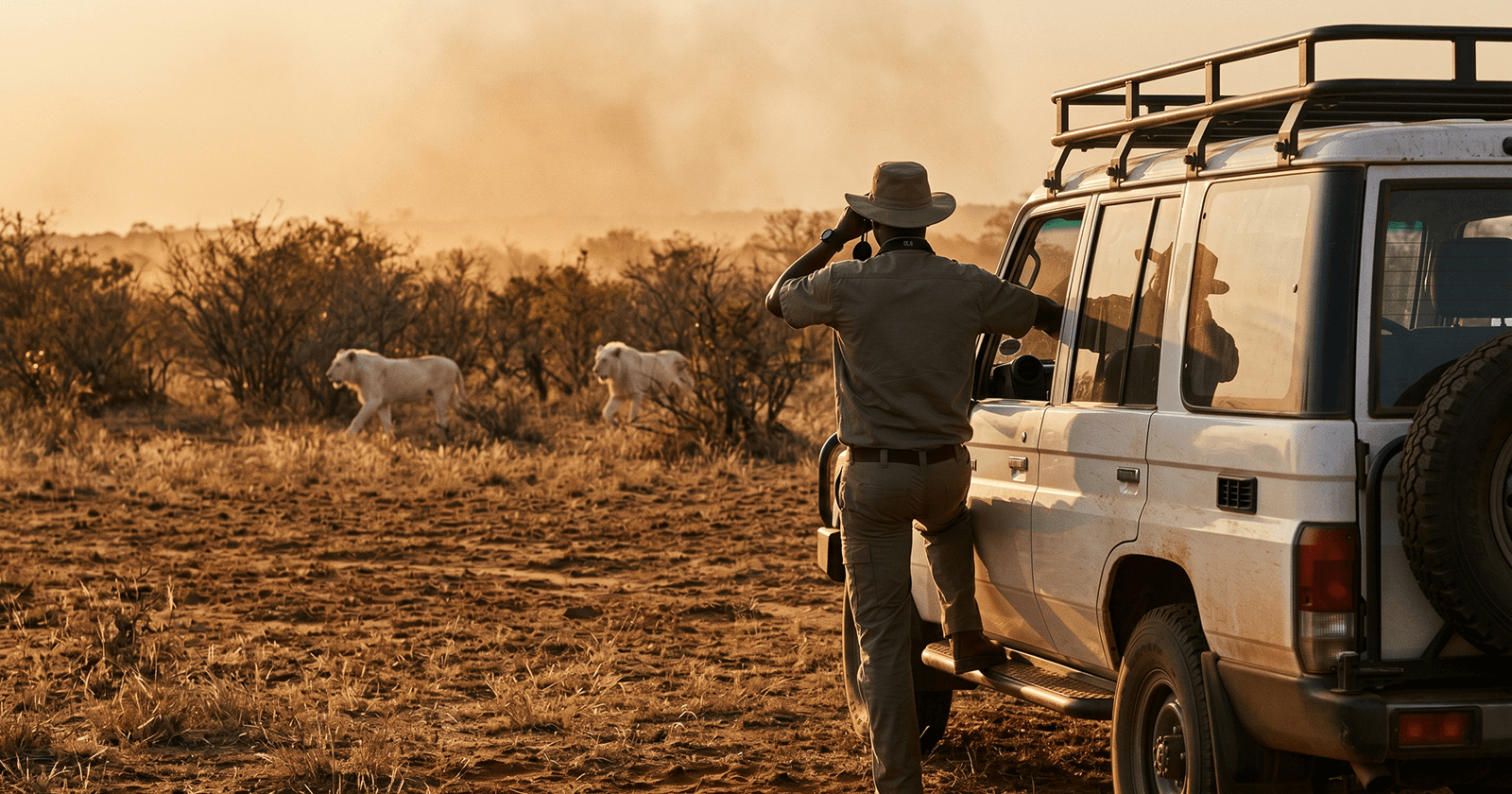
Somewhere in the Timbavati, a white lion is moving through open mopane scrub on ground that has not seen rain in three months. It is not in a reserve designed for it. It is not captive-bred, habituated, or managed. It exists because the granitic shield beneath the Timbavati produces the wide territorial ranges and genetically diverse pride structures that keep a recessive leucism gene viable across generations of wild lions — and because no other landscape on earth currently does the same. Forty kilometres south, in the Sabi Sand, a leopard is cached twelve feet up in a leadwood tree above the Sand River with a kill it will not descend from until nightfall, for reasons that trace back to the same geological argument: alluvial soils, dense vegetation, and a hyena population large enough to make the ground dangerous.
This is the only safari itinerary in the Greater Kruger ecosystem where a single package transitions between those two geological substrates — and understanding why the underlying rock determines what you see and how you see it is the intelligence that separates a genuine field briefing from a booking platform description.
What is the difference between the Timbavati and Sabi Sand for a safari? The Timbavati sits on a granitic geological shield producing open mopane woodland and long plains-game visibility, where the recessive leucism gene that produces white lions persists in a genuinely wild population. The Sabi Sand is defined by the perennial Sand and Sabie River systems, where alluvial soils and permanent water create dense riverine vegetation that supports compressed leopard territories of 10–15 km² — the highest density recorded globally. The two reserves produce fundamentally different wildlife mechanics: the Timbavati demands tracking skill over vast terrain; the Sabi Sand delivers stationary, prolonged predator sightings in vertical habitat. Combining both within one itinerary gives the traveller genuine biological contrast rather than a repeat of the same ecosystem at a different lodge.
Explore the 7-Day Sumptuous Timbavati and Sabi Sand Safari on Safari.com
The Granite Shield of the Timbavati
The Timbavati Private Nature Reserve sits on the Western Escarpment of the Limpopo bushveld, where basement granite forms a shallow, nutrient-deficient substrate that limits tree cover and drives the open mopane shrub and mixed savanna characteristic of the area. The consequence of this geology is ecological: it produces the browse-heavy conditions that support large concentrations of elephant, buffalo, and plains game — and it creates the long sight lines across open country that define the Timbavati's game viewing character. This is not the enclosed, dappled world of a riparian forest. It is a wide, hot, amber landscape where distance is part of the experience.
The geological context becomes critical when explaining the white lion phenomenon. The recessive gene responsible for leucism — the partial loss of pigmentation that produces the Timbavati's white lions — first emerged in wild cubs documented here in 1975. Unlike the captive-bred white lions found elsewhere in South Africa, the Timbavati population represents the only recorded instance of this genetic expression persisting in a genuinely free-roaming wild population. That persistence is not incidental to the reserve's ecology. The open granitic savanna supports the large territorial ranges — up to 50,000 hectares of unfenced traversing rights — that allow a genetically diverse lion population to sustain the recessive trait without the forced inbreeding that defines captive programmes.
At Kings Camp, the arrival sequence sets the operational register immediately. The bush strip landing is followed by the scent of wild sage and crushed acacia under tyres, the thatch-and-dark-wood architecture a deliberate echo of colonial field-station aesthetic rather than modern glass-and-concrete game lodge design. The crested francolin's staccato call is the dominant sound in the golden hour before the afternoon drive. This property operates within approximately 25,000 acres of private traversing rights, working with a two-person tracking team — a dedicated tracker reading spoor ahead of the vehicle and a guide interpreting species behaviour in real time. That combination is the field intelligence delivery system that makes the Timbavati's wide terrain navigable. You do not stumble onto a white lion sighting here. It is earned through track and spoor across open ground.
Mid-morning walk-and-track walking safaris in the Timbavati operate with a distinct tactical advantage specific to this geology. The granitic substrate produces firm, damp earth at the edges of seasonal watercourses — exactly the surface that holds clean impressions of animal movement from the previous night. A lion track pressed into this material at dawn, sidelit by the low first-light sun, reads as clearly as a sentence on a page to a skilled tracker. White lion prides in the Timbavati are known to cover substantial distances between dusk and dawn, and finding their spoor trail before midday heat hardens the surface is the operational window the morning walk is designed to exploit.
The Alluvial Corridor: How the Sand and Sabie Rivers Built the Leopard Capital
The Sabi Sand's claim to the highest leopard density on earth is not a marketing statement. It is a function of the reserve's hydro-geology. The perennial Sand and Sabie River systems deposit deep alluvial soils along their banks and floodplains, which support the dense fever tree (Vachellia xanthophloea) and riparian vegetation that provides the vertical structure leopards require for territory establishment and kill caching. The result is a compressed habitat matrix where territorial boundaries overlap significantly — territories as small as 10–15 km² have been documented — producing the high-frequency sighting rates that make the Sabi Sand the most reliable leopard destination in Africa.
The vegetation density that makes the Sabi Sand's leopard population so visible is also what makes it structurally different from the Timbavati. The dappled, humid light filtering through a riverine canopy, the scent of damp river sand and fever tree bark, the sharp evening temperature drop as cold air off the river settles into the woodland — this is a sensory environment built for ambush predation, and the leopards that use it have been habituated over decades to vehicle presence. The result is not just a sighting but a prolonged behavioural observation. A leopard caching a kill in a leadwood tree above the Sand River at blue hour, backlit by the last colour in the sky with the still water surface reflecting below, is not an encounter that requires luck. The habitat trap creates it reliably.
The mechanism behind this reliability is technically specific. The Sabi Sand sustains a significant spotted hyena population, and it is this hyena pressure that drives leopards into the vertical dimension — caching kills in trees rather than consuming them at ground level. Trees with strong, horizontal branching structures at the right height — leadwoods, marulas, jackalberry figs — are critical infrastructure in a leopard's territory. The high-density vegetation of the alluvial soils provides these trees in concentration. This is why the Sabi Sand produces not just frequent leopard sightings but stationary, elevated, prolonged ones: the habitat structure forces the behaviour that the viewer can then access.
Leopard Hills Private Game Lodge sits on a ridge within approximately 10,000 hectares of the Western Sabi Sand, with glass-fronted suites overlooking the Sand River corridor. The heated plunge pools and oversized baths are incidental to the field intelligence value. What matters is the positioning: a ridge-top property above the river valley gives the guide team overlook access to the movement corridors below, and the Western Sabi Sand's traversing rights include off-road access into the thickets where leopards are most reliably found at rest or with kills. For a deeper review of this property's photographic and operational capabilities, the Leopard Hills Private Game Lodge article covers the field detail in full. For the broader context of Sabi Sand dynamics and how the reserve compares against its neighbours, the Sabi Sands Private Safari South Africa guide is the relevant reference point within the Krantz library.
Night drives in the Sabi Sand operate until approximately 20:00 with infrared spotlights, extending the leopard observation window into the period of peak nocturnal activity. The same compressed territory density that makes daylight sightings reliable makes the night drive a high-conviction tactical tool: within a small territory, a leopard that was resting in a tree at sunset has not gone far by the time the evening drive departs from the lodge.
Reserve your place on the Timbavati and Sabi Sand Safari on Safari.com
White Lions and the Wild Genetic Record
The Timbavati's white lions are the only free-roaming leucistic lions documented in any wild population on earth. That sentence should be read slowly, because it is the kind of claim that gets softened by repetition until it stops registering — and it shouldn't. White lions in the Timbavati are tracked, not staged. They move freely across a reserve larger than many national parks. Their territory overlaps with normally pigmented pride members, which is how the recessive gene is maintained across generations without genetic bottlenecking.
What the field data does support is that the Timbavati's tracking infrastructure gives the visitor the most legitimate access to wild white lions available anywhere on earth. The two-person tracking team at Kings Camp operates with a detailed knowledge of the current pride territories, seasonal movement patterns, and preferred water sources across the reserve's 25,000 acres. On any given morning, the combination of fresh spoor reading and a network of ranger communication across the reserve places the vehicle within striking distance of a white lion sighting with meaningful statistical reliability during peak game-viewing months of June through August, when the low winter grass maximises visibility across open ground.
The genetic story behind these animals is worth framing before you leave the lodge. The leucism gene requires two carrier parents to produce a white cub. In the Timbavati's wild population, that means the gene must be circulating through multiple individuals across adjacent pride territories without selection pressure eliminating it. The open granitic savanna, with its wide territorial ranges and large prey base, is what allows the pride structure to sustain this. Compress the habitat — as has happened in captive breeding contexts — and the gene pool narrows. The Timbavati's geology, in effect, is what keeps the white lion genetically viable.
The Leopard's Habitat Trap: A Technical Summary
It is worth stating the core mechanism clearly before the comparison table, because it is the intelligence that makes the case for the Sabi Sand's pricing against a standard Greater Kruger alternative.
Leopards in the Sabi Sand are visible frequently, for extended periods, and in behavioural contexts — kills, caching, territorial marking, maternal behaviour — that go far beyond a roadside sighting, for three mechanistically connected reasons. First, the alluvial soils of the Sand and Sabie systems support the vegetation density that creates ideal leopard habitat. Second, that vegetation density also supports a high hyena population, which drives leopard caching behaviour into trees rather than the ground. Third, the resulting high tree-use makes leopards visually accessible from a vehicle in ways that ground-level behaviour would not permit. Remove any one of these three conditions and the sighting quality collapses. All three conditions are a function of the hydro-geology. This is not a game reserve that happened to develop a high leopard population. It is a landscape that structurally produced the conditions for it.
The standard Greater Kruger public park alternative offers none of these conditions at scale. Vehicle density at sightings in the public section of Kruger routinely exceeds ten vehicles, and roads are restricted to tar and gravel, preventing the off-road access into thickets that the Sabi Sand's private vehicle and guide system allows. The tracking intelligence — a dedicated tracker reading spoor ahead of the vehicle — is absent from the public park model entirely.
Comparing the Two Reserves: Multi-Destination Field Intelligence
| Field | Timbavati (Kings Camp) | Sabi Sand (Leopard Hills) |
|---|---|---|
| Geology / Terrain | Granitic savanna / open mopane shrub | Riparian forest / alluvial riverine |
| Water Source | Seasonal Timbavati River / man-made pans | Sand and Sabie Rivers (perennial) |
| Primary Wildlife Driver | White lion genetics / herd concentration | Leopard density / territorial overlap |
| Signature Experience | Tracking "Giraffe Star" white lions | Watching leopard kills in leadwood trees |
| Best Activity | Mid-morning track-and-spoor walking safari | Night drives for nocturnal predation |
| Peak Season | June–August (low winter grass, visibility maximised) | May–September (river concentration, leopard activity) |
| Transfer Method | PC-12 / Cessna Caravan fly-in (HDS to Kings Camp, ~45 min) | Lodge-to-lodge road or charter (Arathusa/Skukuza, ~30–60 min) |
The Field Intelligence Case for Combining Both Reserves
The value argument for a dual-reserve itinerary is not that you see more animals. It is that you experience two fundamentally different explanations for why animals behave as they do. In the Timbavati, the open granitic landscape makes the tracking process itself legible — you can understand why the tracker is reading the angle of a track impression to determine direction of travel, and why the granite soil holds that impression more clearly than red Kalahari sand would. In the Sabi Sand, the mechanism shifts to vegetation structure and water permanence — you understand why the leopard is in a tree, why it is in that particular tree, and why it will likely stay there for the next several hours.
That second layer of field comprehension — understanding the geological and ecological cause behind each sighting — is what a specialist publication can deliver that no booking platform's copy ever will. It also changes what you actually see. A visitor who understands that the Timbavati's open savanna is a function of nutrient-poor granite soils reads the landscape differently from the moment the bush strip landing is complete. A visitor who understands that the Sabi Sand's leopard density is mechanically produced by alluvial soils, riparian vegetation, and hyena pressure watches a caching event with a different level of comprehension.
Value Comparison: Private Reserve vs Standard Kruger Alternative
| Feature | This Package (Timbavati / Sabi Sand) | Standard Kruger Alternative (Public / Entry-Level Private) |
|---|---|---|
| Vehicle density per sighting | Maximum 2–3 vehicles; off-road access permitted | 10+ vehicles; restricted to tar and gravel roads |
| Tracking team | Dedicated tracker plus guide (two-person system) per vehicle | Single guide / driver only |
| Predator access | Off-road approach into thickets for stationary leopard sightings | Visual access limited to roadside proximity |
| Night access | Infrared spotlights and nocturnal tracking until ~20:00 | Strictly closed after sunset (gate times enforced) |
| Logistics | Private airstrip fly-in transfers (lodge-hopping capability) | Long-distance road transfers (5–7 hours) |
| Ecological contrast | Two distinct geological substrates and wildlife mechanics | Single reserve ecosystem throughout |
Nearby Experiences: Beyond the Reserve Boundary
The Hoedspruit corridor that connects the Timbavati to the Sabi Sand contains a concentration of specialist experiences that extend the field intelligence value of the itinerary significantly.
The Moholoholo Wildlife Rehabilitation Centre near Hoedspruit runs on a different clock from the reserves. Here the animals that arrive are the ones the bush failed to protect — a martial eagle grounded by a power line strike, a leopard cub pulled from a snare, a brown hyena dehydrated past the point of self-recovery. The specialist tour is not a sanctuary visit. It is a working clinical operation, and watching a rehabilitation team assess a large raptor's flight mechanics before a release decision is a more precise education in African predator biology than any game drive produces. It reframes everything you saw in the field.
The Hoedspruit Endangered Species Centre (HESC) focuses specifically on cheetah conservation and houses one of the most technically credible rhino orphanage programmes in southern Africa. Visiting before or after the reserve portion of the itinerary positions the sightings in the field within a conservation mechanics framework that most safari experiences never provide.
For guests with altitude tolerance, microlight flights over the Greater Kruger periphery from Hoedspruit provide an aerial perspective on the landscape's geological structure that is simply not available from the vehicle. Seeing the boundary between the granitic Timbavati and the alluvial lowveld from 1,500 feet makes the ecological argument of this article visible in a single image.
The Blyde River Canyon Helicopter Excursion, departing from Hoedspruit, combines the Panorama Route landmarks — God's Window, Bourke's Luck Potholes, the Three Rondavels — into a single aerial and ground circuit that frames the Greater Escarpment geology that ultimately produces the Timbavati's character downstream. This is not sightseeing. It is the visual counterpart to the field intelligence that the tracking team delivers on the ground.
For guests connecting through the Hazyview corridor, Elephant Whispers provides educational interaction with rescued African elephants at an operational level that goes beyond the standard interaction programme — the emphasis is on elephant cognition, herd behaviour, and conservation status rather than performance or spectacle.
When to Go and How to Get There
The optimal travel window for this itinerary sits between May and August, when the dry season reduces grass cover in the Timbavati to a level that maximises lion and white lion visibility across open ground, and the Sabi Sand's perennial rivers concentrate prey species at permanent water along the Sand and Sabie systems. This is the period when leopard caching behaviour is most active as hyena pressure peaks at seasonal waterholes, and when the morning tracking sessions in the Timbavati produce the clearest spoor impressions on firm, cool soil.
Fly-in access is the only logical entry point for this itinerary. Scheduled flights from Johannesburg O.R. Tambo (JNB) to Eastgate Airport (HDS) serve the Timbavati sector, with a ground transfer of approximately 45 minutes to Kings Camp. The Sabi Sand leg is accessed via Arathusa or Skukuza (SZK), with a 30–60 minute transfer to Leopard Hills. The lodge-to-lodge internal transfer is most efficiently handled as a charter flight between the two airstrips, eliminating the 2–3 hour road transfer and preserving a full afternoon game drive on the day of transition.
Both properties operate on a fully inclusive basis covering accommodation, all meals, premium spirits, twice-daily game drives, and walking safaris. No additional costs accrue in the field beyond curio purchases and personal expenses.
Malaria: the Timbavati and Sabi Sand are malaria zones. Prophylaxis consultation with a travel medicine practitioner before departure is a standard logistical requirement, not an optional precaution.
People Also Ask
Is Sabi Sand or Timbavati better for leopards? The Sabi Sand is the stronger choice for leopard-focused safaris. Compressed territory sizes of 10–15 km² and decades of vehicle habituation produce stationary, prolonged sightings in the alluvial riverine vegetation — a leopard caching a kill in a leadwood tree above the Sand River is a repeatable outcome here, not an exceptional one. The Timbavati's open granitic savanna is not ideal leopard habitat — it is white lion and plains game terrain. If leopard frequency and behavioural depth is the primary objective, the Sabi Sand is unambiguously the stronger reserve.
Can you see white lions in the Timbavati in 2026? Wild white lions remain present in the Timbavati population. They cannot be guaranteed on any specific drive, as they roam freely across the reserve's full 50,000-hectare traversing territory. The tracking infrastructure at Kings Camp — a two-person team of dedicated tracker and guide per vehicle — gives guests the highest legitimate probability of locating white lions in a wild setting available anywhere on earth. June through August, when low grass cover maximises visibility, represents the optimal tracking window. The Timbavati's white lions are the only free-roaming leucistic lions documented in a wild population globally.
What is the difference between Sabi Sand and Kruger National Park? Sabi Sand is an unfenced private reserve adjacent to Kruger's western boundary, operating under a private concession model that permits off-road vehicle access, no vehicle density limits at sightings, dedicated two-person tracking teams, and night game drives — none of which are available in the public Kruger park. Kruger's road-restricted, multi-vehicle sighting experience and closed-after-sunset access rules are trade-offs against its lower cost and the sheer scale of terrain it covers. For predator sighting quality and behavioural depth, the private reserve model is not comparable to the public park experience.
How many days do you need for a Timbavati and Sabi Sand safari? Seven days represents the practical minimum for experiencing both reserves with adequate depth — three to four nights in each location allows for sufficient repeat game drives to cover the full range of species and behavioural contexts each reserve produces. Fewer than three nights in either location limits the statistical likelihood of a white lion encounter in the Timbavati and reduces the chance of witnessing the full leopard caching-and-feeding cycle in the Sabi Sand. Extending to ten days allows a more measured pace and greater exploration of the Sabi Sand's night drive programme.
Are there fences between Sabi Sand and Timbavati? Both the Timbavati and Sabi Sand are unfenced private reserves sharing an open boundary with Kruger National Park, allowing free movement of wildlife between the reserves and the public park. There is, however, no direct unfenced boundary between the Timbavati and Sabi Sand — the two reserves are adjacent zones within the Greater Kruger ecosystem but operate as separate management areas with their own traversing territories. Animals that range across both reserves include leopard, lion, elephant, buffalo, and the Timbavati white lion prides, whose territory sizes can span multiple reserve management zones.
What geological feature explains the Sabi Sand's leopard density? The perennial Sand and Sabie River systems deposit deep alluvial soils along the western boundary of the Greater Kruger, supporting the dense riverine vegetation and permanent water that creates ideal leopard habitat. This habitat sustains a high hyena population, which in turn drives leopard kill-caching behaviour into trees — making leopards consistently visible in elevated, stationary positions that vehicle-based observers can access. The compression of territories to 10–15 km² is a direct function of habitat quality: where food and cover are concentrated, territory sizes decrease and sighting frequency increases proportionally.
Kings Camp vs Leopard Hills: which is right for which traveller? Kings Camp in the Timbavati is the correct choice for the traveller whose primary objective is white lion tracking, plains game concentration, and the open granitic savanna experience — a landscape that rewards patience, spoor reading skill, and an appreciation of African ecological systems operating at scale. Leopard Hills in the Sabi Sand is the correct choice for the traveller whose primary objective is predator behavioural depth — prolonged leopard sightings, nocturnal hunting sequences, and the intimate river-corridor atmosphere of the Western Sabi Sand. Combined within a single seven-day itinerary, they represent the most technically differentiated dual-reserve package available in the Greater Kruger system.
Book the 7-Day Sumptuous Timbavati and Sabi Sand Safari
Krantz Outdoors is a specialist pan-African safari research publication. Our editorial team aggregates field intelligence from professional trackers, wildlife photographers, and conservation scientists to deliver technically verified safari briefings.
This article is compiled from operator specifications, verified field reports, and specialist ecological research. Krantz Outdoors conducts independent editorial review of all promotional content.
Affiliate disclosure: This article contains affiliate links. If you book through our Safari.com, Krantz Outdoors may earn a small commission at no additional cost to you. We only recommend experiences we genuinely believe in.
Wild by Nature. Africa by Choice.
Read our Privacy Policy and Terms & Conditions