
15-Day Safari Adventure — Botswana, Victoria Falls & Zanzibar
Where Four Geological Worlds Collide: The Field Intelligence Briefing Booking Platforms Don't Provide
Wild by Nature. Africa by Choice.
Most safari itineraries are assembled around lodge brands and departure logistics. This one is different. The 15-Day Safari Adventure spanning Botswana, Victoria Falls, and Zanzibar is, at its geological core, a journey across four entirely separate planetary events — a seismically governed dry-season river, an alluvial megafan fed by Angolan highlands, a basaltic gorge carved by one of the most violent waterfalls on earth, and a coral-rag island anchored in the Indian Ocean. The wildlife experiences those geological forces produce are specific, non-replicable, and unavailable anywhere else on the continent. Understanding why the earth is the way it is here explains everything that lives on it — and makes every game drive, every mokoro glide, and every sundowner on the Zambezi read as something more than scenery.
What is a Botswana Luxury Fly-in Safari?
A Botswana luxury fly-in safari is a privately accessed, multi-ecosystem safari circuit conducted entirely via light aircraft between camps, eliminating road transfers and allowing guests to cover radically different ecological zones — from the arid Savuti Channel in the Chobe interior to the papyrus waterways of the Okavango Delta — within a single itinerary. The 15-Day Safari Adventure on Safari.com adds the Victoria Falls corridor and Zanzibar to this circuit, combining four distinct African ecosystems across a single 15-day arc with Belmond-quality accommodation throughout.
Explore the 15-Day Safari Adventure on Safari.com
The Earth Beneath the Itinerary: Why Four Geological Zones Make This Safari Different
The majority of safari itineraries are geologically homogeneous. Sabi Sands, Greater Kruger, and most of Tanzania's Northern Circuit sit within broadly similar granite-over-ancient-basement geological systems where the wildlife and vegetation patterns are ecologically coherent. What makes this 15-day itinerary unusual — and what booking platforms entirely fail to articulate — is that every leg of the journey sits on a different geological substrate, each one producing a distinct set of ecological conditions, wildlife concentrations, and photographic opportunities.
Savuti operates on seismic logic. The Okavango is built on alluvial fan hydrology fed by rainfall 1,200 kilometres away. Victoria Falls sits on a basalt plateau that the Zambezi has been systematically dismantling for millennia. Zanzibar is coral rag and ancient reef — as different from the Kalahari sand as it is possible to be while still sitting on the same continent.
This is not accidental itinerary design. These four zones represent the full breadth of Southern and East African geological diversity compressed into a single journey. For the reader with a genuine interest in field intelligence — not just the list of species seen — this itinerary operates as a master class in how the earth produces the wildlife that lives on it.
Savuti: The River the Fault Line Stole — and the Lions It Created
The Savuti Channel does not flow because of rainfall. It flows — or does not flow — because of seismic activity along the Linyanti fault system, a tectonic boundary that sits beneath the flat Kalahari interior of the Chobe National Park. Subtle shifts in the fault tilt the gradient of the land, either allowing water from the Linyanti Swamp to move into the Savuti depression or sealing it off entirely. The channel has been effectively dry for extended periods in recorded history — most recently from the late 1970s to 2010 — and has flooded again, receded, and fluctuated based not on local weather patterns but on the geology beneath.
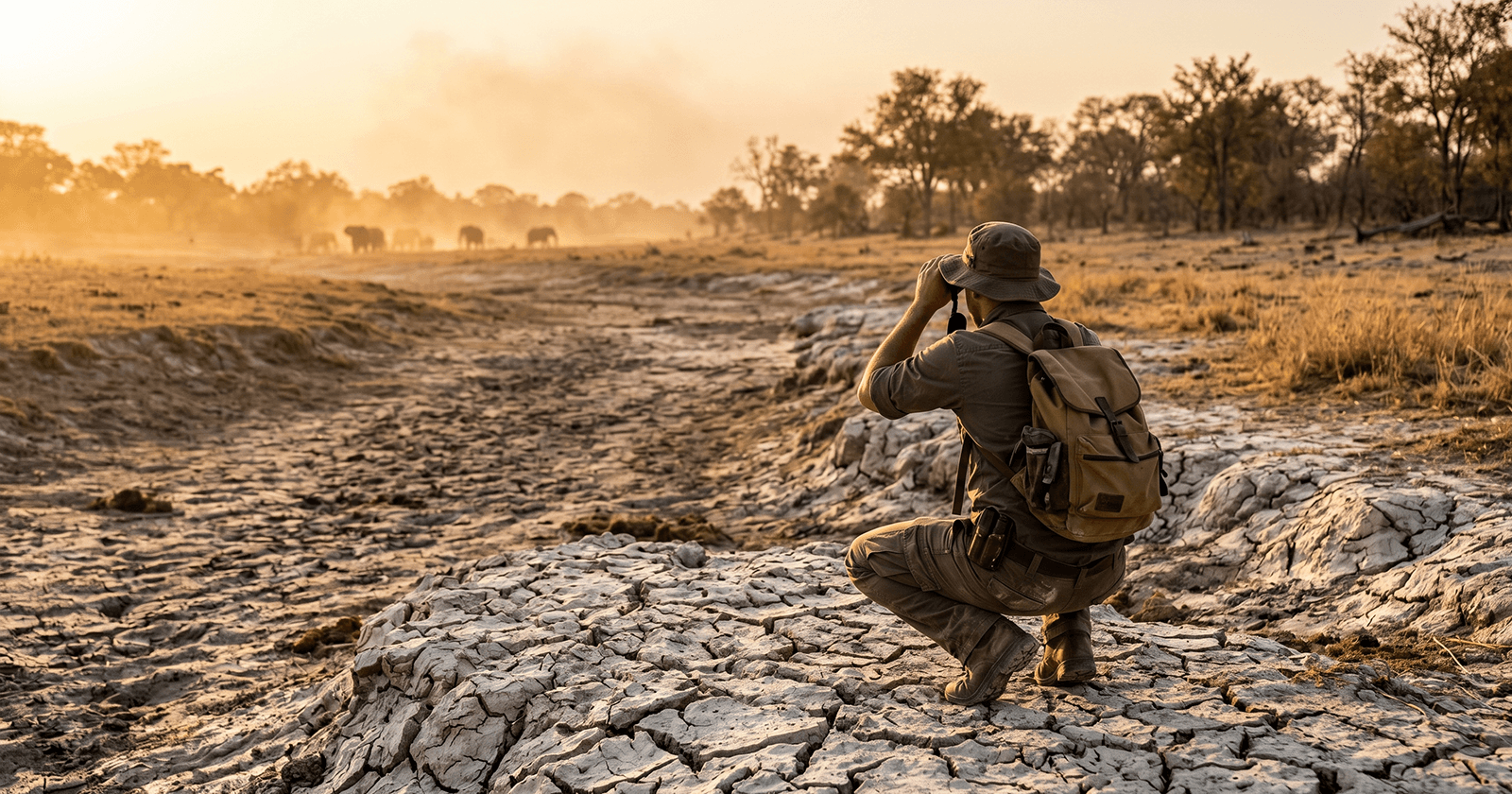
The consequence of this for wildlife is extraordinary. When the Savuti dries, the smaller plains game that depends on surface water migrates out of the area. The herbivore community that remains is dominated by elephants — capable of covering vast distances to access water and large enough to excavate it from dry riverbeds with their feet. Chobe hosts the largest elephant population on the continent, and the Savuti area concentrates a significant proportion of that population during dry cycles.
The lions of the Savuti adapted. Faced with a disappearing menu of smaller prey and a landscape increasingly dominated by mega-herbivore biomass, specific prides developed the capacity to hunt and kill adult elephants — a behaviour documented nowhere else in Africa with the frequency or specialisation recorded at Savuti. These are not opportunistic scavenging events. The Savuti Elephant Hunters developed coordinated takedown strategies involving multiple pride members targeting young but fully grown elephants in darkness, executing techniques passed down through lion generations. The behaviour is a direct ecological response to the tectonic logic that governs the channel's water.
For the safari guest arriving at Savute Elephant Lodge, this context transforms every lion sighting. A pride resting on cracked white clay at midday is not simply photogenic. It is the living record of a behavioural lineage forced into existence by the geology beneath the ground they rest on.
Arrival at Savute Elephant Lodge delivers the sensory profile of the Chobe interior at its most concentrated: a sharp desiccated scent of wild sage and sun-baked dust, the air carrying a heavy stillness broken by low-frequency elephant vocalisations from somewhere in the mopane. The light arrives at golden hour as a high-contrast amber sidelight that carves shadows across the white sand and catches the dust rising from distant herds in the middle distance. This is not gentle safari scenery. It has weight to it.
Reserve your place on the 15-Day Safari Adventure on Safari.com
The Okavango Paradox: Flood Intelligence for the Dry Season Traveller
The most counter-intuitive piece of field intelligence the specialist traveller can possess about the Okavango Delta is this: the best conditions for water-based safari arrive during the peak of the Southern African dry season — June through August — when the surrounding Kalahari is at its most parched, the air is at its most arid, and not a drop of rain has fallen in months.
The water is not local. It originates in the Angolan Highlands approximately 1,200 kilometres to the north, falls as wet-season rainfall between November and March, and then flows south across the flattest gradient on the continent — a 60-metre elevation drop across 450 kilometres — through the Okavango River and into the Kalahari sands. The journey takes months. The flood reaches the Delta in June and peaks in late July or August, long after the rains that generated it have ended.
The ecological consequence is a phenomenon with no equivalent elsewhere in Africa. As the flood pulse moves through the Delta's papyrus channels and floodplains, it pushes terrestrial wildlife — buffalo, elephant, zebra, lion, wild dog — toward the outer edges of the permanent water. The drying Kalahari simultaneously concentrates these animals at the Delta's margins with no retreat route. For the safari guest timing their arrival to this window, the result is extreme wildlife density at the interface between floodwater and dry savanna — a convergence that no seasonal logic would suggest if you were reading the rainfall calendar rather than the hydrological one.
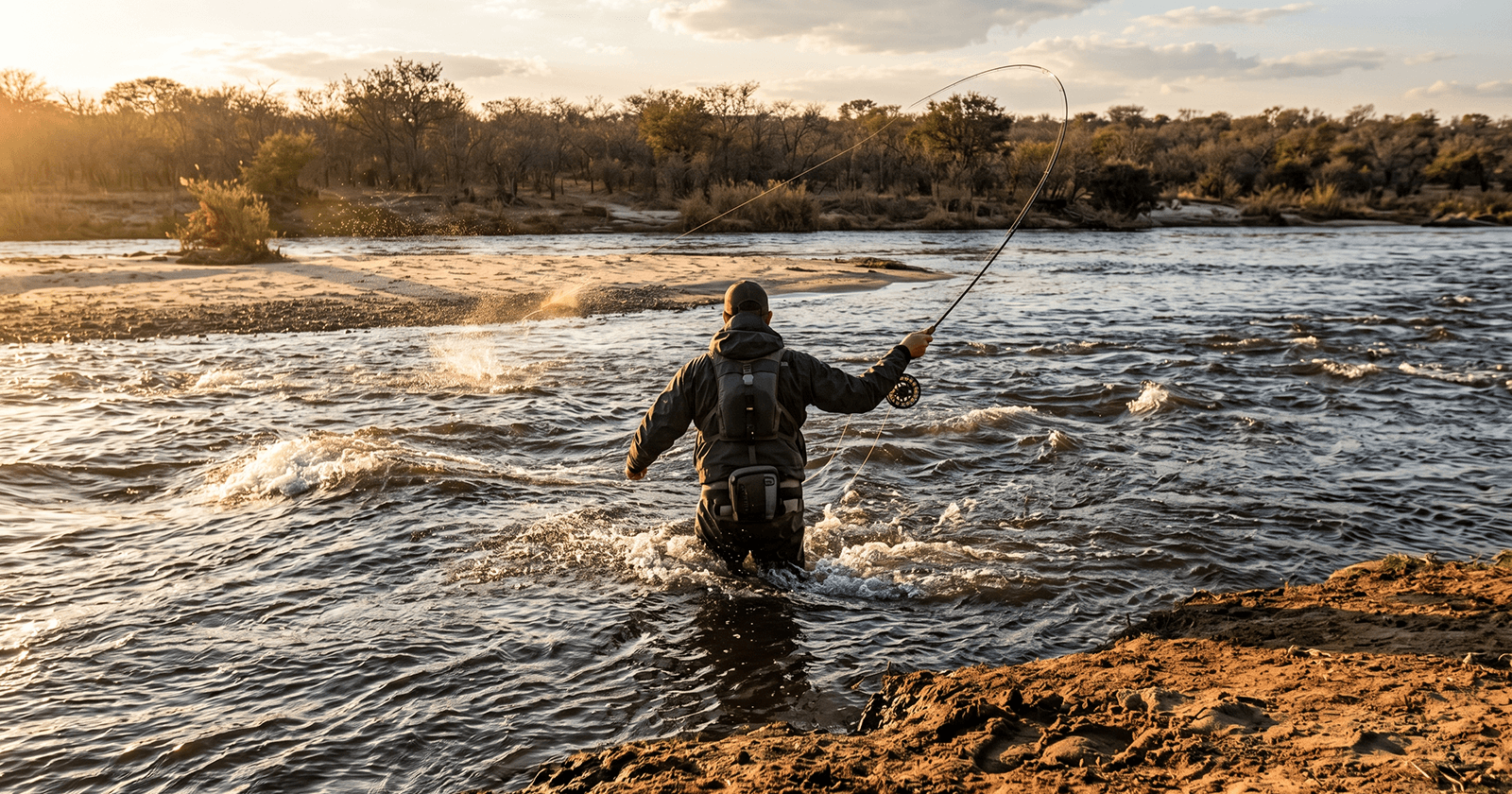
Eagle Island Lodge, accessible only by light aircraft from Maun, sits within this flood zone. The sensory environment shifts entirely from Savuti. The air is cool and humid, carrying the green scent of crushed papyrus and water lilies. The soundscape is a constant layered chorus — Painted Reed Frogs producing a miniature glass-bell rhythm across the channels while lechwe splash through the shallows at dawn. The light comes filtered through riverine canopy, broken into dappled columns and reflected gold off moving water. Elevated tented suites with private plunge pools extend over the water — sound travels differently here, further and quieter simultaneously.
Mokoro excursions depart before dawn, the channels navigated in silence by standing polers whose technique reads the depth and current of the water with a push and correction that takes years to develop. The mokoro is not a vehicle. It is a method of arrival that removes the traveller from the landscape's mechanical logic entirely.
This is what separates the Okavango from every other African water-based safari environment. The water that makes it extraordinary did not fall here. It arrived from another country, on a schedule governed by gradient and geology rather than climate, and it fills the dry season with life at precisely the moment when everything south of it is retreating from the heat.
For readers planning extended water-based access to Botswana's delta systems, the luxury safari Botswana to Zambia article covers the Okavango and Lower Zambezi circuit in detail and provides useful comparative field intelligence for multi-ecosystem itinerary planning.
Victoria Falls and the Basalt Corridor: Reading the Zambezi's Geological Violence
The standard Victoria Falls narrative focuses on volume and spectacle — the 1,708-metre width of the falls, the spray cloud visible from forty kilometres, the Smoke That Thunders. These are accurate facts that tell the wrong story.
The more useful piece of geological intelligence is this: Victoria Falls does not fall vertically because the Zambezi River found a cliff edge. It falls vertically because the Zambezi found a crack. The basalt plateau of the Batoka Gorge region is ancient lava flow — Karoo Supergroup basalt, laid down approximately 180 million years ago — and the rock is riddled with vertical fault lines, joints, and fissures running roughly east to west. The Zambezi has been exploiting these fault lines systematically for millions of years, retreating upstream through each successive fissure as the water erodes the lip and the gorge moves. The current falls location is simply where the river currently encounters the most accessible joint in the rock.
The Batoka Gorge below the falls is therefore not a valley. It is a sequence of abandoned river channels — a geological record of where the falls have previously been, written in basalt and deep water. Viewed from a microlight or helicopter at low altitude, the zigzag pattern of the successive gorges is visible and legible: each right-angle bend in the gorge marks a former falls position, each straight section a former waterfall face.
Victoria Falls River Lodge sits on the Zambian bank above the gorge system, with tented suites positioned on private decks overlooking the Zambezi upstream of the falls. The river here is wide, relatively calm, and carries the characteristic basalt-brown colouration of water that has been in contact with the plateau geology for hundreds of kilometres. Game viewing along the Zambian bank includes elephant, hippo, and buffalo moving between the Mosi-oa-Tunya National Park and the river corridor. The spray zone of the falls creates a permanent rainforest microclimate on the Zambian side — a narrow band of tropical vegetation growing at the edge of an otherwise dry-country landscape, the geological consequence of 550 million litres per minute of water mist distributing moisture regardless of the seasonal calendar.
Activities in the Victoria Falls corridor extend well beyond the falls themselves. White-water rafting in the Batoka Gorge offers some of the most technically demanding rapid sequences in the world — Class V commercially rafted water between the gorge walls. The Livingstone Island experience on the Zambian side provides access to Devil's Pool during high-water season, a natural infinity pool at the edge of the main falls face. Helicopter "Flight of Angels" circuits cover the full gorge system and deliver the geological overview that ground-level access cannot.
Guests connecting through this leg will find the Victoria Falls safari package review useful for understanding the full Zambezi corridor experience — particularly the national park game drive intelligence and riverside wildlife density data for this specific section of the river.
Zanzibar: Coral Rag, Ocean Currents, and the Safari's Final Transition
The transition from Victoria Falls to Zanzibar is the itinerary's most radical geological shift. The basalt plateau and sand systems of the African interior give way entirely to an Indian Ocean archipelago sitting on a foundation of coral rag — ancient fossilised reef limestone that forms the island's skeleton and gives the beaches their characteristic white-powder texture.
Zanzibar's marine environment is governed by the Indian Ocean monsoon system rather than the African continental weather patterns that have defined every preceding leg of the journey. The northeast monsoon (Kaskazi) and southeast monsoon (Kusi) drive seasonal water temperature, visibility, and marine wildlife concentrations. The Mnemba Atoll, lying four kilometres off the northeast coast, is one of the Indian Ocean's most productive snorkelling and diving environments — a protected marine reserve with coral coverage, hawksbill and green turtle populations, spinner dolphins in year-round residence, and whale shark aggregations during specific seasonal windows driven by oceanic current and plankton density.
Stone Town's historical intelligence adds a further dimension that pure marine tourism does not capture. The Swahili coast trade routes that made Zanzibar the centre of the Indian Ocean's spice and slave economy for centuries left an architectural and cultural record unlike anything on the African mainland. The historical Spice Route tours operate from Stone Town through plantations where cloves, nutmeg, vanilla, and black pepper grow in the same soil as they have for two centuries. The Jozani Forest, on the island's south-central ridge, protects the endemic Red Colobus Monkey — a subspecies found only on Zanzibar, separated from its mainland relatives by the evolutionary isolation of island geography.
For the guest arriving after twelve days in the African interior, Zanzibar's transition is not a dilution of the safari experience. It is its geological conclusion — the final piece of evidence that the continent this journey has traversed is built on a diversity of tectonic and oceanic processes that no other destination on earth can replicate in a single itinerary.
Logistics, Fly-in Access, and What the Booking Platforms Don't Tell You
The architecture of this itinerary is built around light aircraft transfers between private airstrips — a logistics model that eliminates the road-transfer dead time that compromises multi-destination East African circuits and allows for genuine day-of-arrival game drive access from the first afternoon.
Botswana fly-in transfers between the Savuti and Okavango camps operate on Cessna 208 Caravan or similar light aircraft from private concession airstrips — 20 to 45 minutes between camps. Baggage restrictions apply: soft bags only, 20 kilograms maximum including hand luggage. Rigid-frame cases are not compatible with this transfer system and must remain in Maun or Kasane if the journey is self-organised outside the package.
The private concession access that covers both the Savuti and Okavango legs is the single most significant operational differentiator over the standard circuit. National Park regulations in Botswana prohibit off-road driving, night drives, and walking safaris from vehicles on public roads. Private concessions operate under entirely separate access rules — off-road tracking, spotlight night drives, and guided walking are all available. The predator intelligence that both camps are built around — the Elephant Hunter lion prides at Savuti, the specialist wildlife concentration at the Okavango flood edge — is most effectively accessed in the early morning darkness and the hour after sunset when light levels and animal movement produce encounter quality impossible on daytime public road circuits.
The Victoria Falls to Zanzibar connection operates via commercial aviation from Livingstone or Victoria Falls Airport. This is the one logistical seam in the itinerary and requires layover management — typically through Johannesburg or Nairobi. The package handles these connections, but the forward-planning traveller should note that Zanzibar's international arrivals at Abeid Amani Karume International Airport are subject to yellow fever certificate requirements for travellers arriving from sub-Saharan African countries.
Value Comparison: This Package Against the Standard Circuit
The following table compares the 15-Day Safari Adventure against a standard 15-day "Southern Circle" itinerary covering comparable destinations via road transfer and national park access.
| Feature | 15-Day Belmond / Safari.com Package | Standard 15-Day Southern Circle |
|---|---|---|
| Logistics | All fly-in via private airstrips | Mix of road transfers and commercial connections |
| Bush Access | Private concessions — off-road, night drives, walking permitted | National Park public roads only |
| Predator Density | High — Savuti Elephant Hunter prides, Eagle Island specialist concession | Variable — high-traffic national park roads |
| Accommodation | Belmond tented luxury with private plunge pools | Standard safari chalets and lodges |
| Guide Ratio | Maximum 6 guests per vehicle | Up to 10 guests per vehicle |
The Ecosystem Intelligence Framework below anchors the specialist differentiation of each leg within the itinerary's geological narrative.
Each destination in this itinerary sits on a distinct geological system producing a specific wildlife experience. The table below maps these relationships:
| Destination | Geology / Terrain | Water Source | Primary Wildlife Driver | Signature Experience | Best Activity | Peak Season | Transfer |
|---|---|---|---|---|---|---|---|
| Savuti | Arid rhyolite and Kalahari sand | Savuti Channel — seismic fault control | Elephant and Elephant Hunter lion conflict | Savuti pride nocturnal hunts | Night drive with specialist guide | July–October | Light aircraft |
| Okavango | Alluvial fan and Kalahari sand | Angolan Highlands flood — 1,200km travel delay | Dry-season flood pulse concentration | Mokoro silent safari at dawn | Mokoro and guided bush walk | June–August | Light aircraft |
| Victoria Falls | Basalt plateau — Karoo Supergroup lava | Zambezi River — Upper Zambezi catchment | Spray-zone rainforest and gorge wildlife corridor | Batoka Gorge view and white-water | Helicopter circuit / white-water rafting | March–May (high water) | Road and boat |
| Zanzibar | Coral rag and ancient reef limestone | Indian Ocean monsoon system | Mnemba Atoll reef system and turtle populations | Dhow sunset cruise and Mnemba snorkelling | Marine snorkelling / Stone Town Spice Route | July–September | Commercial air |
People Also Ask
When does the Okavango Delta flood peak? The Okavango Delta flood typically peaks between late July and August. The water originates in the Angolan Highlands and travels approximately 1,200 kilometres across the Kalahari's near-flat gradient, taking several months to arrive. The flood therefore peaks during the dry season, making July and August the optimal window for both maximum water levels and concentrated terrestrial wildlife at the flood margins.
Is Savuti better than the Okavango for seeing lions? Savuti offers a higher probability of encountering the specific Elephant Hunter pride behaviour — coordinated hunts on adult elephants — that is unique to the Linyanti fault system. The Okavango provides different predator encounters, including leopard and wild dog on the Delta's terrestrial edges, with lion sightings concentrated where flood and savanna meet. Neither destination is categorically superior — they offer ecologically distinct experiences governed by their respective geological and hydrological systems.
How do you transfer from Botswana to Zanzibar? Transfers from the Botswana camps to Zanzibar are made via commercial aviation, typically connecting through Johannesburg OR Tambo International or Nairobi Jomo Kenyatta. The package manages these connections from Victoria Falls or Livingstone Airport. Zanzibar requires a yellow fever vaccination certificate for travellers arriving from sub-Saharan Africa. Passengers should confirm visa requirements — most nationalities receive a visa on arrival at Zanzibar's international airport.
What are the benefits of a fly-in safari vs road transfer? Fly-in access eliminates transfer dead time between camps, allows same-day arrival game drives from private airstrips, and provides access to remote concessions unreachable by road in reasonable time. The critical operational benefit in Botswana specifically is private concession access — the concessions surrounding both the Savuti and Okavango camps permit off-road driving, night drives, and walking safaris that are prohibited on national park public road networks.
Do Savuti lions really hunt elephants? Yes. The Savuti Elephant Hunter prides represent a documented and multigenerational behavioural adaptation to the seismically governed dry cycles of the Savuti Channel. When the channel dries and smaller prey migrates out, the lion prides evolved coordinated strategies to take down sub-adult and adult elephants — using darkness, numbers, and specific takedown techniques. This behaviour has been filmed and studied extensively in the Savuti area and is considered a direct ecological response to the tectonic fault system that controls the channel's water cycle.
How do tectonic fault lines affect wildlife in Chobe? The Linyanti fault system determines whether the Savuti Channel carries water into the Chobe interior or seals off entirely. When the fault tilts to allow flow, the channel provides surface water that supports diverse plains game and reduces prey concentration. When the fault seals the channel — as it did from the late 1970s to 2010 — the smaller prey migrates out, elephant densities increase, and the lion prides that remain face an ecosystem dominated by mega-herbivore biomass. The wildlife of the Savuti is therefore not determined by rainfall or season but by the geology beneath it — making the Savuti fundamentally unlike any other African predator ecosystem.
Book the 15-Day Safari Adventure — Botswana, Victoria Falls & Zanzibar
Krantz Outdoors is a specialist pan-African safari research publication. Our editorial team aggregates field intelligence from professional trackers, wildlife photographers, and conservation scientists to deliver technically verified safari briefings.
This article is compiled from operator specifications, verified field reports, and specialist destination research. Krantz Outdoors conducts independent editorial review of all promotional content.
Affiliate disclosure: This article contains affiliate links. If you book through our Safari.com links, Krantz Outdoors may earn a small commission at no additional cost to you. We only recommend experiences we genuinely believe in.
Wild by Nature. Africa by Choice.
Read our Privacy Policy and Terms & Conditions