
Masai Mara Tracking Safari — How Entim's Maasai Guides Read the Reserve Before Dawn
Generational bush-craft, kill-site forensics, and zero-commute predator intercepts: the tracking intelligence that separates Entim Mara Camp from every other property in the ecosystem.
Wild by Nature. Africa by Choice.
Introduction
Most safari guests believe a great sighting begins when the animal appears. Entim Mara Camp's Maasai guides know it begins the night before — in the acoustic map of lion contact calls audible from the tented suites after midnight, in the direction a hyena's whooping call is answered from the eastern ridge, in the specific timbre of an oxpecker alarm that places a buffalo herd in the drainage line before first light has broken over the Mara escarpment.
The Masai Mara National Reserve covers 1,510 square kilometres of open savanna, riverine forest, and seasonal drainage systems. Within that area, at any given moment, there are approximately nine resident lion prides, a dense leopard population using the Talek and Sand River riparian corridors, cheetah coalitions working the open grassland plains, and hyena clans whose territorial boundaries have remained stable across generations. Finding any of these animals on a given morning is not a matter of driving until something appears. It is a matter of reading the reserve's overnight record — the kill sites, the drag marks, the scat deposits, the alarm call sequence — and making an intelligent intercept decision before the morning wind erases the scent evidence.
Entim Mara Camp's Maasai guides have been reading that record since childhood. This article is about what they read, how they read it, and why the camp's position inside the reserve at the Mara-Talek confluence makes the reading possible in a way that no external-conservancy property can replicate.
If your primary objective at Entim is the river crossing shot rather than the tracking intelligence behind finding it, our wildlife photography review covers the positional advantage in full.
Featured Snippet
What makes a Masai Mara tracking safari at Entim Mara Camp different from a standard game drive?
A standard Masai Mara game drive follows roads and responds to sightings already in progress. Entim Mara Camp's tracking safari begins before the vehicle moves — with Maasai guides analysing overnight kill sites, reading moisture content in predator scat to establish feeding timelines, and triangulating lion contact calls audible from camp against known territorial boundaries. Because Entim is positioned inside the reserve at the Mara-Talek river confluence, guides operate within the active predator corridor from first light, with zero gate transit time. Every morning drive departs with a targeted intercept plan based on overnight acoustic and physical evidence — not a random patrol of main reserve roads.
📌 Book the 3-Day Masai Mara Explorer at Entim Mara Camp
Zero-commute predator intercepts from inside the reserve. Maasai tracking intelligence. All meals, game drives, and airstrip transfers included.
The Mara Radio: Reading the Reserve's Acoustic Intelligence
Before any physical track evidence is examined, before the vehicle leaves camp, the Mara's acoustic network has already been transmitting for hours. Entim's Maasai guides understand this network at a level that no classroom-trained guide can replicate — because the language of the Mara radio is learned through decades of immersive exposure, not a field guide.
The system operates on several distinct channels simultaneously. Oxpeckers — the red-billed and yellow-billed tick birds that feed on the parasites of large mammals — produce a specific, sharp alarm chirp when a large predator moves through their host animal's vicinity. The call is directional, brief, and immediately interpretable to an experienced ear: it places the predator relative to the host animal, establishes movement direction, and indicates urgency level based on call repetition rate. A single oxpecker alarm from the acacia thicket north of the Talek at 5:15am tells a Maasai guide something specific. A cascade of the same alarm moving east along the drainage line tells him something more specific still.
Zebra produce a distinctive single-bark alarm that differs from their contact call and their distress vocalisation. Impala produce a nasal snort-alarm that carries extraordinary distance in still air. The go-away bird — named for the clarity of its warning call — broadcasts from elevated perches and tends to track large predator movement with remarkable reliability. None of these signals are subtle to a trained ear. All of them are invisible to a guest arriving at the reserve gate at 6:30am, by which time the morning's acoustic intelligence has been broadcasting, evolving, and in many cases concluding for two hours.
Entim's camp position makes the difference. The tented suites are positioned along the Talek River corridor — within an active lion territorial boundary. Contact calls are audible from the camp's dining deck before the pre-dawn briefing begins. Guides have been mentally mapping the overnight movement pattern while guests are finishing breakfast. The morning game drive departs with an acoustic intelligence summary already in hand.
Kill-Site Forensics: The Evidence That Disappears by Midday
Physical track evidence in the Masai Mara has a lifespan governed by the equatorial sun and the morning wind. By 9am, the dew that preserved overnight scent trails has evaporated. By 10am, the Mara's thermals have begun redistributing airborne scent in ways that make directional tracking unreliable. The window for kill-site forensics is narrow and front-loaded — which is precisely why Entim's zero-commute advantage translates directly into tracking intelligence quality.
A kill site in the Mara ecosystem is a multi-layer document. The primary evidence — the carcass itself, or what the hyenas and vultures have left of it — tells the experienced guide what species was taken, the approximate time of the kill based on decomposition rate and insect activity, and which predator made the kill based on the consumption pattern. Lions cache their kills differently from leopards. Cheetahs feed differently from both. The bite pattern on bone, the drag distance, the height of any cached portion — these are diagnostic details.
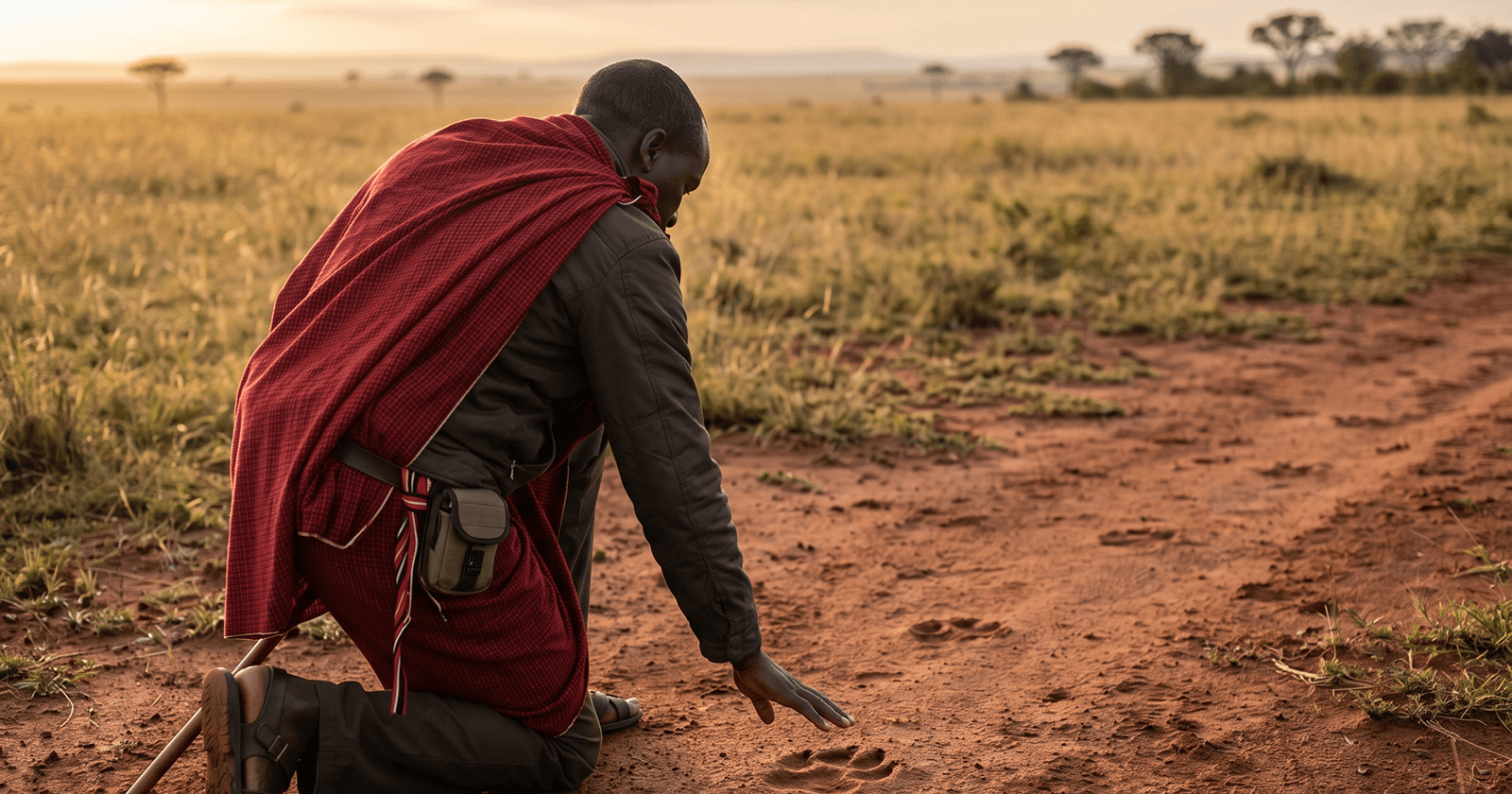
The secondary evidence is more temporally sensitive and more operationally valuable. Drag marks in the soil indicate direction of carcass movement after the kill — useful for locating a leopard that has cached prey in a tree, or a lion pride that has moved a wildebeest carcass into cover for secondary feeding. Scat deposits near the kill site provide a feeding timeline: fresh scat with high moisture content indicates an animal that fed within the last two to three hours. Dry, white-chalked scat indicates a feed from the previous evening. The difference matters significantly for the intercept plan — a pride that fed heavily four hours ago is likely lying up in nearby shade, digestively immobile and highly predictable. A pride that fed yesterday evening has had time to move and may require a broader search pattern.
Entim's guides are on foot at overnight kill sites before the morning drive departs. This is not a standard practice at Mara camps that must first transit 20 to 40 kilometres of reserve road. It is an operational capability that flows directly from mid-reserve positioning — and it is what produces the targeted intercept plan rather than the random road patrol.
No booking platform describes what happens at a Mara kill site before dawn — but it is precisely this intelligence that separates an Entim game drive from every other vehicle on the reserve road. Book the 3-Day Masai Mara Explorer and arrive with guides who have already done the forensics before breakfast.
Lion Territorial Mechanics: Reading the Boundary System
The Masai Mara's lion population is structured around territorial boundaries that are maintained through scent marking, contact calling, and occasional boundary enforcement that can escalate to lethal conflict between prides. These boundaries are not fixed on a map — they shift seasonally with prey distribution and are contested along edges when populations are dense. But the core territorial structure of a given section of the reserve tends to remain stable across seasons and years, which means that guides with long-term site knowledge can use territorial mechanics as a predictive tool.
Entim's Maasai guiding team holds generational knowledge of the specific pride territories that overlap the camp's game drive circuit — the section of the reserve encompassing the Mara-Talek confluence and the river corridors extending north and west from the camp. This knowledge is not recorded in a field guide. It is transmitted through family and community, accumulated over decades of observation, and updated continuously through daily interaction with the reserve. A guide who grew up in the Mara ecosystem and has worked within it for 20 years knows which kopje a specific sub-adult male uses as a territorial marking point, which drainage line a particular pride uses as a movement corridor between their northern and southern range boundaries, and how long after first rain the grassland prey distribution shifts enough to trigger a territorial renegotiation along the Talek's eastern bank.
This is what the term "Maasai bush-craft" actually means in operational tracking terms. It is not a romantic description of traditional skills. It is a body of site-specific ecological knowledge that has direct and measurable consequences for the guest's morning game drive outcome.
Understanding Alarm Call Sequences: The Field Intelligence No App Delivers
The practical skill of interpreting multi-species alarm call sequences is one of the highest-level competencies in African field guiding, and it is almost never discussed in safari marketing because it cannot be photographed or easily explained in a booking platform description. It is, however, the difference between a guide who drives toward a sighting after it has been reported on the radio network and a guide who arrives at the sighting location before the animal has been disturbed.
A typical predator-approach sequence in the Mara unfolds as follows. A lion moving through open grassland at dawn triggers a zebra alarm at the outer edge of the herd's flight-initiation distance — approximately 80 to 120 metres for a relaxed zebra herd, significantly closer if the herd has been stationary and is already on alert. The zebra bark alarm carries further than the flight response is visible, meaning a guide 500 metres away hears the alarm before the zebra have moved. The direction of subsequent zebra movement — whether the herd consolidates and faces toward the threat or fragments and flees — tells the guide whether the lion is moving or stationary.
Simultaneously, any impala in the adjacent area produce their nasal snort-alarm and orient toward the threat. The composite picture — zebra alarm at bearing 340 degrees, impala orientation at bearing 325 degrees, oxpecker cascade moving east along the tree line — triangulates the predator's position and movement direction with enough precision to position the vehicle ahead of the animal's travel line before it is visible.
This is the practical application of alarm call intelligence. It requires no radio network, no tip from another guide, and no luck. It requires a guide who has spent years learning the specific vocalisation patterns of every large mammal and bird species in the ecosystem and who can process multiple simultaneous signals while driving, briefing guests, and adjusting vehicle position.
Entim's Maasai guides operate at this level as a baseline competency — not as a specialist add-on to the standard game drive experience.
The Leopard Problem: Why River Corridors Are the Key
Leopard sightings in the Masai Mara are consistently rated among the most sought-after and most difficult to guarantee of all Big Five encounters — and the reason is structural. Leopards are solitary, cryptic, primarily nocturnal in their active phase, and use dense riparian vegetation as both a movement corridor and a daytime refuge. Finding a leopard in the Mara is almost entirely a function of knowing the river system.
The Talek River, which forms the eastern boundary of Entim's primary game drive circuit, supports one of the highest leopard densities in the Mara ecosystem. The riparian vegetation along the Talek provides year-round cover, a reliable prey base in the form of impala and reed buck using the river's edge, and fig and sycamore trees with the branching architecture that leopards prefer for caching kills above the reach of hyenas. A leopard that makes a kill in the open grassland adjacent to the Talek will almost invariably cache it in the river's tree line — making the Talek corridor the primary search area for leopard activity in Entim's section of the reserve.
Entim's guides know specific trees along the Talek that are used repeatedly as cache sites by individual leopards. They know the sub-adult female that patrols the river's northern bend, the scarred male that holds the territory from the camp's eastern boundary to the Talek-Mara confluence, and the approximate territory overlap zone where the two animals' ranges intersect — which is also where the highest frequency of territorial scent-marking occurs and therefore where the highest probability of a daytime sighting exists.
This is site-specific intelligence. It is not available on a booking platform, a review site, or a field guide. It lives in the observation record of guides who have walked this section of river for years.
The 3-Day Tracking Itinerary: What the Schedule Delivers
A three-day itinerary at Entim, approached with tracking intelligence as the primary objective, delivers a structured escalation of field knowledge across the stay.
Day one functions as orientation and calibration. The morning drive establishes the current territorial state of the predator population in the camp's game drive circuit — which prides are active in which sections, where the current kill-site activity is concentrated, and what overnight acoustic evidence has suggested about the previous night's predator movement. The afternoon drive applies this intelligence to a targeted search pattern, typically focusing on the Talek corridor and the open grassland plains adjacent to the river's eastern bank.
Day two is the intercept day. Informed by the previous day's acoustic and physical evidence, the morning drive departs with a specific target and a specific predicted location. The failure rate of targeted predator intercepts from a mid-reserve camp with experienced Maasai guides is meaningfully lower than the hit rate of random-patrol game drives from gate-entry camps — not because the animals are more visible, but because the search intelligence is more accurate.
Day three consolidates the ecological picture. By this point, guests have sufficient contextual knowledge to understand what they are observing — not just the visual spectacle of a lion pride but the territorial mechanics, the hierarchy, the feeding history, and the behavioural predictions that turn a sighting into a field ecology lesson.
For guests planning a broader East African itinerary that extends the tracking intelligence framework into Tanzania's Serengeti ecosystem — where different prey density, vegetation structure, and predator population dynamics create a distinct tracking environment — the 8 Day Exclusive Northern Tanzania Migration Safari provides the comparative field intelligence for the southern circuit.
Practical Preparation: What to Bring for a Tracking-Focused Safari
The tracking-focused safari guest benefits from a specific preparation approach that differs from the standard photography or general wildlife itinerary.
A field notebook is more useful than most guests expect. Guide briefings deliver significant information density — territorial boundaries, species-specific behavioural indicators, alarm call identification — and retention improves substantially with written notes. Some guests find that the note-taking habit also reframes the game drive experience from passive observation to active participation, which changes the quality of the entire stay.
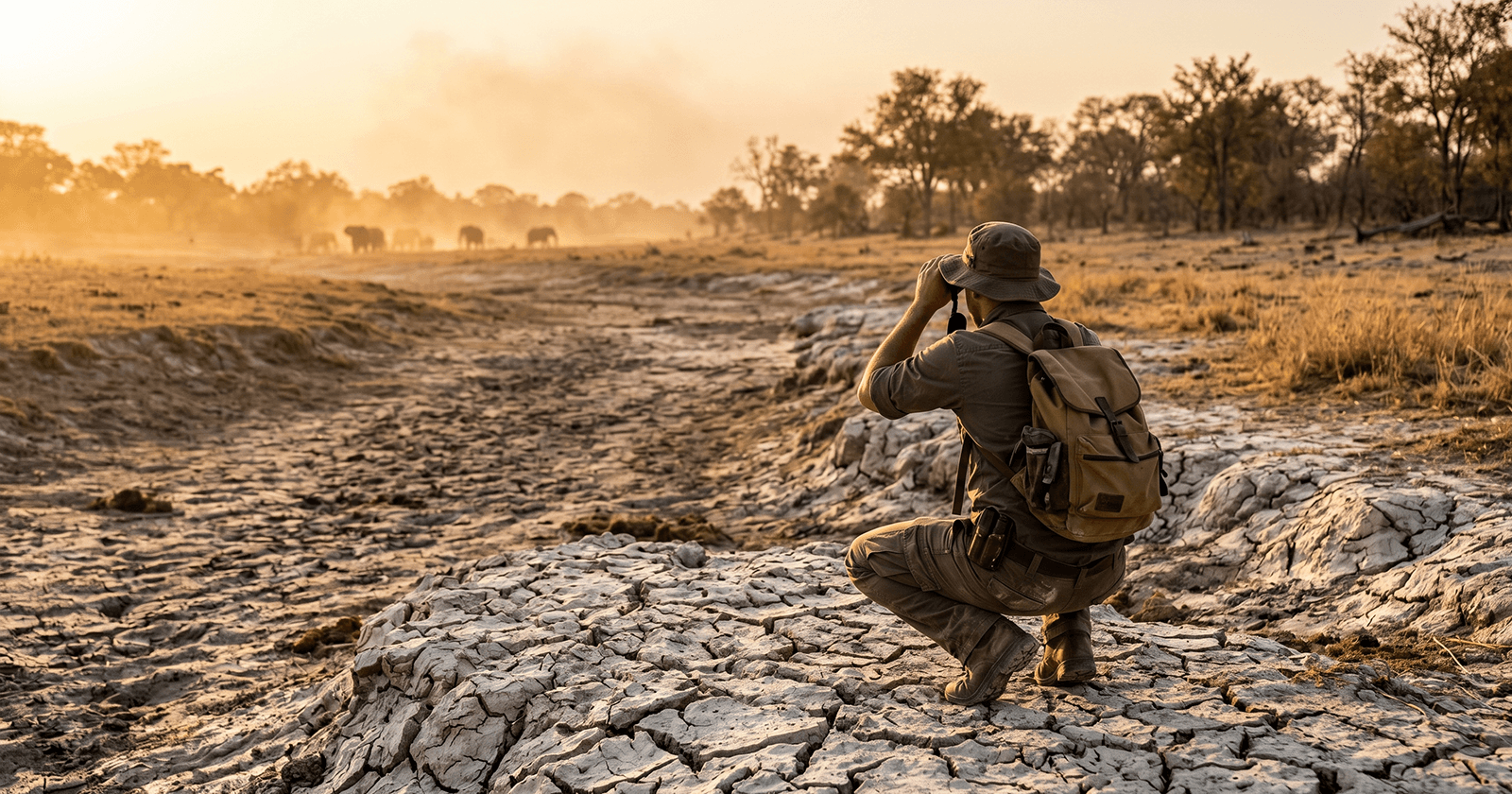
Optics matter for tracking as much as for photography. Long-range subject identification — determining whether a distant moving shape is a cheetah or a hyena, reading the body language of a lion at 300 metres to assess whether the animal is resting or alert — requires binoculars with adequate light transmission and magnification stability. The same optical performance criteria that govern binocular selection for plains game hunting in African conditions apply directly to the tracking context. The Best Binoculars for Hunting in Southern Africa — 2026 Guide addresses these specifications in detail, including low-light transmission performance relevant to dawn tracking operations.
Clothing in the Mara's morning temperature range — typically 12 to 16 degrees Celsius before sunrise, rising to 28 to 30 degrees by midday — requires a layering approach. The pre-dawn departure that maximises tracking intelligence value requires warm layers that can be shed as temperatures rise through the morning drive.
People Also Ask
How do Maasai guides track lions in the Masai Mara?
Maasai guides track lions through a combination of acoustic intelligence, physical track evidence, and territorial knowledge accumulated over years of site-specific observation. Before the morning game drive departs, experienced Maasai guides at mid-reserve camps like Entim analyse overnight kill sites — examining scat moisture content to establish feeding timelines, reading drag marks to determine carcass movement direction, and mapping the previous night's lion contact calls against known territorial boundaries. During the drive, guides monitor multi-species alarm call sequences from zebra, impala, and oxpeckers to triangulate predator position and movement direction in real time. The combination of pre-drive forensic analysis and in-drive acoustic interpretation produces targeted predator intercepts rather than random road patrols.
What is the best time of day for wildlife tracking in Kenya?
The optimal tracking window is the 90 minutes immediately before and after sunrise — roughly 5:30am to 7:30am during the Mara's July to October peak season. During this period, overnight scent trails are preserved by dew, drag marks in the soil retain maximum definition, and predators that fed overnight are in the process of transitioning from active movement to daytime rest. The morning thermal activity that disperses scent evidence begins around 9am. By midday, most of the physical forensic evidence from the previous night's predator activity has degraded beyond interpretable quality. This is why mid-reserve accommodation that permits zero-commute first-light access to kill sites produces materially better tracking intelligence than camps that require 30 to 60 minutes of gate transit before entering the active predator corridor.
Can you go off-road in the Masai Mara for tracking?
The Masai Mara National Reserve enforces a road-use policy that restricts off-road driving in most sections of the reserve — a conservation measure designed to prevent grassland degradation under high vehicle density. This is operationally distinct from the adjacent private conservancies, where off-road movement is generally permitted. The road restriction does not significantly constrain experienced Maasai tracking guides, who use acoustic intelligence and terrain knowledge to position vehicles on existing roads ahead of animal travel lines rather than following tracks across open ground. The skill of predicting where an animal will emerge — based on its movement direction, the terrain structure, and the guide's knowledge of the specific individual's behaviour patterns — is a higher-level tracking competency than simply following a track off-road.
What do different animal alarm calls mean on safari?
Each species produces distinct alarm vocalisations with specific informational content. Zebra produce a single sharp bark that indicates large predator proximity — the call's urgency escalates with repetition rate. Impala produce a nasal snort-alarm that carries significant distance in still air and is often the earliest indicator of a predator approaching through dense vegetation. Oxpeckers produce a rapid, insistent chirp alarm when their host animal is approached by a large predator — the call is directional and tracks the predator's movement relative to the host. The go-away bird broadcasts from elevated perches and tends to follow large predator movement with high reliability. Experienced Maasai guides process multiple simultaneous alarm signals to triangulate predator position, identify movement direction, and predict the animal's travel line — all before the predator is visually confirmed.
Why is mid-reserve accommodation better for tracking predators?
Mid-reserve accommodation eliminates the gate transit time that costs external-conservancy guests the most productive tracking window of the day — the 90 minutes after first light when overnight kill-site evidence is at maximum interpretability and predators are completing their transition from active movement to daytime rest. At Entim Mara Camp, guides can be at an overnight kill site before 6am, conducting scat and drag-mark analysis before the morning thermals begin dispersing scent evidence. The camp's position at the Mara-Talek confluence also means that lion contact calls from the resident prides are audible from camp before dawn, providing overnight movement intelligence before the vehicle turns over. The combined effect — acoustic pre-drive mapping and first-light forensic analysis — produces targeted intercepts that external-conservancy camps cannot replicate regardless of guide quality.
📌 Experience Entim's Tracking Intelligence Firsthand
Three days inside the reserve. Maasai guides who read the Mara before dawn. All meals, game drives, and airstrip transfers included.
Krantz Outdoors is a specialist pan-African safari research publication. Our editorial team aggregates field intelligence from professional trackers, wildlife photographers, and conservation scientists to deliver technically verified safari briefings.
This article is compiled from operator specifications, verified field reports, and specialist photography research. Krantz Outdoors conducts independent editorial review of all promotional content.
Affiliate disclosure: This article contains affiliate links. If you book through our Safari.com, Krantz Outdoors may earn a small commission at no additional cost to you. We only recommend experiences we genuinely believe in.
Wild by Nature. Africa by Choice.
Read our Privacy Policy and Terms & Conditions