Top 5 Compact Drones for Safari Wildlife and Landscape Photography — 2026 Buyer's Guide
The drone that earns its place on an African safari isn't the one with the best specification sheet. It's the one that survives the heat, clears the regulatory threshold, stays quiet enough not to disturb the subject, and still delivers images good enough to justify the risk of carrying it.
Wild by Nature. Africa by Choice.
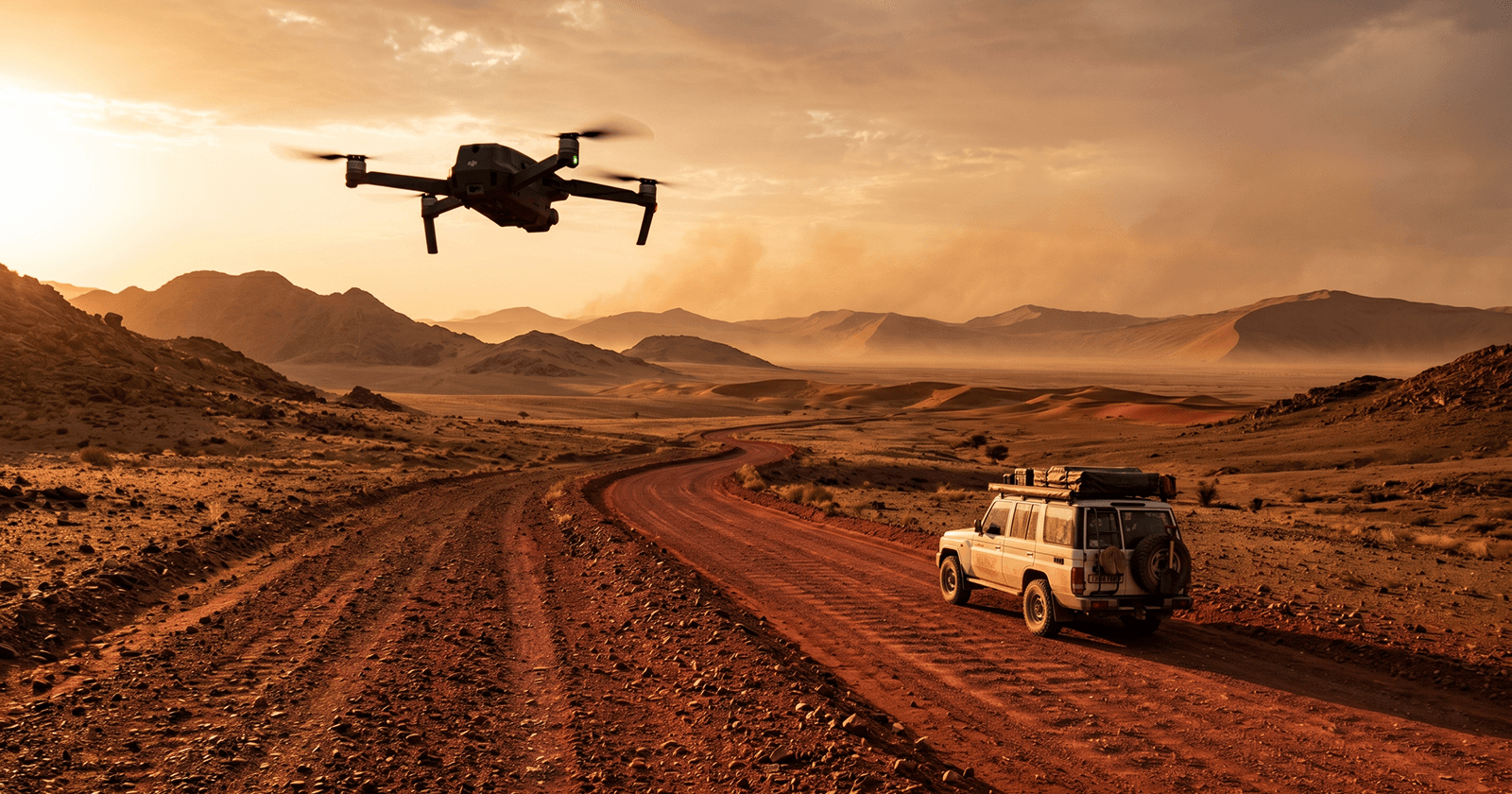
There is a specific irony at the heart of drone photography in Africa. The continent that offers the most spectacular aerial subjects — the Okavango floodplain at peak water, the Serengeti plains during the migration, the red Namibian dunefields at golden hour — is also the continent with the most restrictive drone regulations. Most of Africa's national parks and major game reserves prohibit recreational drone use entirely, and the consequences of non-compliance range from equipment confiscation to arrest. Before any drone on this list earns a place in your kit bag, you need to understand what it can and cannot legally be used for in your specific destination.
Every drone evaluated in this guide is assessed against one specific use case: legal aerial photography and videography in African safari contexts where drone operation is permitted — private game reserves with prior approval, open landscape corridors outside protected park boundaries, Namibia's desert and coastal zones, the Victoria Falls corridor where permits are obtainable, and private land where the operator has confirmed clearance. This is not a guide for park rangers, licensed documentary filmmakers, or SANParks conservation operations. It is a field intelligence briefing for the serious safari traveller who has done the regulatory work and wants to know which drone survives the conditions and delivers the images.
Both products are evaluated as standalone aerial systems — not as substitutes for a proper telephoto lens on a safari. For the reader choosing a lens for their Sony mirrorless body, the best sony e-mount lens for african safari wildlife comparison covers that decision in detail. Drones and telephoto lenses serve different compositional objectives and are not interchangeable.
What is the best compact drone for safari wildlife and landscape photography?
The DJI Air 3S is the strongest all-round choice for the serious safari aerial photographer. Its 1-inch CMOS sensor, 45-minute flight time, and dual-camera system deliver professional-grade stills and video across the full range of African light conditions — from pre-dawn blue hour over the Okavango to golden hour above Namibia's red dune corridors — while its wind resistance and obstacle avoidance make it reliable in the unpredictable atmospheric conditions of the African field. For operators who need sub-250g for maximum regulatory flexibility across multiple African countries, the DJI Mini 5 Pro is the correct alternative.
Explore the DJI Air 3S on Amazon
The Field Context: What a Safari Drone Actually Has to Survive
The African field environment is hostile to electronics in ways that European and North American drone testing does not capture. Ambient temperatures regularly exceed 40°C in the dry season across Botswana, Namibia, and Zimbabwe — conditions that reduce lithium battery performance measurably and trigger thermal protection shutdowns in cheaper hardware. Fine particulate dust from Kalahari red earth and Namibian desert sand penetrates every gap in unprotected housings. Vehicle vibration from corrugated tracks stresses gimbal calibration. Rapid temperature shifts — from a cold pre-dawn camp atmosphere to full midday heat within two hours — cause optical condensation if the drone is not properly managed between flights.
The drone you carry on safari also has to travel there. All lithium batteries must be in carry-on luggage on every airline leg. Bush aircraft — the Cessna 206s and Caravan transfers that connect remote lodges — have strict weight and bag-size limits that make a heavy, bulky drone case a liability before it ever leaves the ground. Sub-250g drones avoid registration requirements in many African jurisdictions. Heavier drones typically require permits, registration, and in some cases commercial operator certification to fly legally.
And then there is the wildlife. African park authorities prohibit recreational drones specifically because drone noise at altitude stresses animals — particularly elephants, which have been documented abandoning river crossings when drones pass overhead, and wildebeest, which have panicked and scattered during migration due to drone intrusion. Flying responsibly in permitted areas means understanding your drone's noise output, staying at altitude, and never approaching wildlife directly. The best safari drone is also the quietest one at distance.
The full range of relevant safari optics and observation gear — from binoculars for the game drive to rifle scopes for the ethical hunting context — is covered in the Hunting Binoculars South Africa 2026 guide for readers building out a complete field observation kit.
The Performance Ceiling: What No Drone Can Beat in the African Field
Every drone on this list — and every drone available at any price point — shares the same external performance ceiling in the African field. Understanding it before you evaluate any specification is the only honest starting point.
Heat shimmer and turbulence are the governing atmospheric limits. In open African ecosystems, rising heat creates visible shimmer and unstable air from mid-morning onward on clear days. Drone footage captured in these conditions shows the characteristic distortion that no stabilisation system, sensor size, or lens quality can eliminate — it is an atmospheric phenomenon, not an equipment failure. The practical flying window in open desert and savanna environments is roughly ninety minutes after sunrise and sixty to ninety minutes before sunset. Filming at altitude across open water — the Okavango channels, the Chobe floodplain — typically extends this window because water surfaces moderate thermal convection.
Battery performance is the second ceiling. Every manufacturer's stated flight time is measured in controlled conditions at moderate temperatures. At 40°C ambient in direct sun, lithium battery discharge accelerates. A drone rated at 45 minutes in laboratory conditions may deliver 30 to 35 minutes of real field performance in high-heat Botswana conditions. Carry extra batteries and shade them between flights.
Regulatory compliance is the third and hardest ceiling. No amount of optical or flight performance changes the fact that most of Africa's iconic national park landscapes are no-fly zones. The drone that earns its place in the safari kit bag is the one optimised for the legal windows — private reserves with clearance, landscape corridors outside park boundaries, coastal and desert zones with obtainable permits.
1. DJI Mavic 4 Pro — The Flagship Safari Aerial Platform
The DJI Mavic 4 Pro is the most capable folding drone available to the serious safari aerial photographer in 2026. Its triple-camera system — led by a 100MP Hasselblad 4/3 CMOS sensor with variable aperture capable of 6K/60fps HDR video, alongside dual tele cameras — delivers a level of image quality and creative flexibility that no other consumer drone in this list approaches. The 360° Infinity Gimbal, replacing the traditional hanging mount, enables banking shots and Dutch angle compositions that were previously impossible on a folding drone. Flight time is 51 minutes in controlled conditions.
The field advantage for the safari photographer is specific and defensible: variable aperture on the main camera. The ability to close down from f/2.8 to f/11 gives the Mavic 4 Pro genuine exposure control across the full dynamic range of African light — from the f/2.8 open-wide needed for blue hour and first light over the Okavango, to f/8 or f/11 for managing harsh midday contrast on Namibia's white salt pans. Every other drone on this list shoots at a fixed aperture and relies on ND filters for exposure management. The Mavic 4 Pro's variable aperture is a professional tool.
The limitation for the safari context is weight and regulatory profile. The Mavic 4 Pro weighs approximately 970 grams — well above the 249g sub-registration threshold. Flying it legally in most African jurisdictions requires advance permits, commercial operator registration in some countries, and media clearance for national park adjacent airspace. For the Namibia self-drive or Victoria Falls corridor operator who has done the permit work, this is manageable. For the reader travelling across four countries on a multi-destination safari, the compliance burden is significant.
System extension: Compatible with DJI ND filter sets for exposure control across high-contrast African landscapes. The RC Pro 2 controller with 7-inch tilting screen is available as an upgrade for professional production environments.
Best for the reader who: is a professional photographer or serious content creator, has secured permits for their specific destination, and needs the absolute highest aerial image quality available in a portable folding package — particularly for Namibia landscape work or Victoria Falls corridor commissions.
Price range: $2,249 – $3,299 depending on combo.
2. DJI Air 3S — The Versatile All-Conditions Safari Drone
The DJI Air 3S is the overall winner for the majority of safari aerial photographers. Its 1-inch CMOS sensor with 14 stops of dynamic range captures the wide tonal range of African light — the bright sky against the dark treeline, the silver surface of the Chobe floodplain against the red earth — with a quality ceiling that exceeds what any sub-250g drone can deliver. The dual-camera system — wide-angle and medium telephoto — gives compositional flexibility that a single-lens drone cannot match. Flight time is 45 minutes in controlled conditions, realistically 30 to 35 minutes in high-heat African field use.
The field advantage that matters most in the African context is wind resistance. The Air 3S is heavier than the Mini series at approximately 720 grams, and that mass translates directly to stability in the gusting afternoon winds common across open African plains. The Serengeti and Etosha generate significant thermal-driven afternoon wind from mid-morning onward. The Air 3S holds position in conditions that push a Mini-series drone to its operating limits. For the photographer who needs smooth, stable footage from altitude above an open landscape, this stability is the governing specification.
The limitation is the same as the Mavic 4 Pro at a smaller scale: at 720 grams, the Air 3S triggers registration and permit requirements in most African jurisdictions. It is not a sub-250g regulatory-free drone. Operators must do the permit work before departing for their destination.
System extension: DJI ND filter set for managing exposure across high-contrast golden hour and blue hour conditions. Fly More Combo adds two extra batteries — recommended for full-day field use in heat conditions where battery performance is reduced.
Order the DJI Air 3S on Amazon
Best for the reader who: wants the strongest balance of image quality, wind stability, and flight time in a portable safari aerial system, and has secured permits for their specific destination — particularly for Namibia, Victoria Falls corridor, and private reserve operations.
Price range: $1,099 – $1,499 depending on combo.
3. DJI Mini 5 Pro — The Ultralight Safari Specialist
The DJI Mini 5 Pro is the most significant development in the compact drone category for the African safari traveller in recent memory. At 249.9 grams — precisely under the 250g registration threshold that governs regulatory requirements in most African jurisdictions — it delivers a 1-inch CMOS sensor and 52-minute maximum flight time in a package that can legally be carried on bush aircraft, requires no registration in many African countries for recreational use, and produces Air 3S-level image quality from a fraction of the physical profile.
The field advantage is the regulatory freedom that the sub-250g weight class provides. In Namibia, Zimbabwe, and several other Southern African jurisdictions, drones under 250g face a substantially lower compliance burden than heavier platforms. For the safari traveller moving across multiple countries who cannot invest weeks in advance permit applications for each leg, the Mini 5 Pro's weight class is operationally decisive. The LiDAR-based forward obstacle sensing at 0.1 lux makes it safe to fly in low-light conditions without risking the kind of collision that would destroy the drone and the investment.
The limitation for the serious African landscape and wildlife photographer is that 249.9 grams means smaller motors and less mass — which means the Mini 5 Pro is pushed around by wind more than the Air 3S in the same conditions. In the afternoon gusts common over open Botswana and Namibia plains, it requires more careful flight window selection. It is a morning and evening drone in high-wind environments. It is also not available for direct purchase in the US market through standard retail channels — international travellers outside the US have access to a broader purchasing pathway.
System extension: The Fly More Combo Plus adds the extended battery for up to 52-minute flight time — essential for minimising the number of battery changes needed in high-heat conditions where setup and breakdown adds operational friction.
Best for the reader who: is travelling across multiple African countries on a multi-destination safari, needs sub-250g for regulatory flexibility and bush aircraft compliance, and wants 1-inch sensor image quality in the smallest possible package.
Price range: $759 – $999 depending on combo.
4. DJI Mini 4 Pro — The Smart Entry Point for African Landscapes
The DJI Mini 4 Pro remains one of the most capable sub-250g drones available for the price, and for the safari traveller entering aerial photography for the first time, it is the correct starting point. Its 1/1.3-inch CMOS sensor captures 4K HDR video and 48MP stills with genuine landscape quality. At 249 grams, it sits in the same regulatory weight class as the Mini 5 Pro. Omnidirectional obstacle sensing and ActiveTrack subject following make it forgiving for pilots still developing situational awareness in the field.
The field advantage for the African landscape context is price-to-performance ratio. The Mini 4 Pro delivers genuinely excellent aerial landscape photography at a price point that makes the inevitable field attrition — a hard landing in Kalahari sand, a battery damaged by heat, a gimbal impact on a rocky Namibian track — a manageable financial event rather than a catastrophic one. The reader who is using a drone for the first time in a complex regulatory environment is also the reader who is most likely to make a mistake. The Mini 4 Pro is the correct drone on which to make that mistake.
The limitation relative to the Mini 5 Pro is the sensor. The 1/1.3-inch CMOS chip is smaller than the 1-inch sensor in the Mini 5 Pro and Air 3S, and this difference becomes visible in low-light performance — the blue hour and first light conditions that define the best aerial moments on an African safari. Dynamic range is narrower, noise at higher ISO settings is more pronounced, and the tonal rolloff in shadow recovery is less forgiving. For the photographer who shoots primarily during the golden hour window in good light, the difference is marginal. For the photographer who needs to work in the thirty minutes before sunrise, it is meaningful.
System extension: Compatible with the DJI RC 2 controller with built-in screen for full-sun visibility — recommended for the bright midday conditions of Namibia and Botswana where a phone screen becomes unreadable.
Best for the reader who: is entering safari aerial photography for the first time, wants sub-250g regulatory flexibility, and needs a capable landscape system that delivers excellent results within a budget that accounts for the field attrition risks of a first-time operator in remote Africa.
Price range: $599 – $849 depending on combo.
5. Potensic ATOM 2 — The Budget Alternative That Earns Its Place
The Potensic ATOM 2 is the only non-DJI product on this list, and it earns its place for one specific reason: it is the correct drone for the reader whose primary constraint is budget and who is travelling to destinations where the regulatory environment makes the prospect of a confiscated DJI drone a genuine financial risk worth managing.
At under 249 grams, the ATOM 2 falls in the sub-registration weight class. Its 4K camera with 8K still capture delivers acceptable landscape quality at the price point, and the 3-axis gimbal provides stability sufficient for scenic landscape photography from altitude. The 96-minute claimed flight time across three batteries in the Fly More Combo makes it one of the most field-efficient drones on this list for total daily air time — in heat-reduced battery conditions, three batteries across a full day of sunrise-to-sunset shooting is meaningful.
The limitation is honest and significant: the ATOM 2 is not a wildlife photography drone. Its lack of a telephoto option, smaller sensor, and lower dynamic range mean that it cannot deliver the image quality of the DJI platforms when shooting detail-demanding subjects. It is a landscape and scenic aerial platform at an entry-level price. For the reader who wants sweeping Namibian desert vistas from altitude and has no budget for a DJI system, it is the correct call. For the reader who needs to identify individual animals, capture detail in bird plumage, or deliver professional-grade stills for publication, it is not.
System extension: No meaningful system extension available beyond additional batteries.
Best for the reader who: is operating on a tight budget, travelling to a destination where regulatory confiscation risk makes an expensive DJI platform a financial liability, and primarily wants scenic landscape aerial photography rather than wildlife detail work.
Price range: $299 – $399 depending on combo.
Editorial note: The DJI Avata 2 was researched and considered for this list. It was excluded because its FPV (first-person view) flight system, goggle-based control interface, and lack of a stabilised camera for stills make it fundamentally unsuited to the patient, deliberate field photography that an African safari requires. An excellent drone for a different mission.
The following table summarises the five products across the criteria that govern African field use. All specifications are for the base single-unit configuration.
Before committing to any product, note that the Air 3S and Mavic 4 Pro both require permits in most African jurisdictions for their weight class. The Mini series and ATOM 2 offer significantly lower regulatory friction in the sub-250g category.
| Specification | DJI Mavic 4 Pro | DJI Air 3S | DJI Mini 5 Pro | DJI Mini 4 Pro | Potensic ATOM 2 |
|---|---|---|---|---|---|
| Price Range | $2,249–$3,299 | $1,099–$1,499 | $759–$999 | $599–$849 | $299–$399 |
| Sensor Size | 4/3 CMOS (main) | 1-inch CMOS | 1-inch CMOS | 1/1.3-inch CMOS | 1/2-inch CMOS |
| Max Resolution | 100MP / 6K video | 50MP / 4K video | 50MP / 4K video | 48MP / 4K video | 8K photo / 4K video |
| Claimed Flight Time | 51 min | 45 min | 52 min | 45 min | 32 min (per battery) |
| Weight | ~970g | ~720g | 249.9g | 249g | 249g |
| Variable Aperture | Yes (f/2.8–f/11) | No (fixed) | No (fixed) | No (fixed) | No (fixed) |
| Sub-250g Class | No | No | Yes | Yes | Yes |
| Tele Camera | Yes (dual tele) | Yes (medium tele) | No | No | No |
| Africa Field Rating | Professional/Commercial | Advanced Recreational | Versatile Recreational | Entry Recreational | Budget Recreational |
| System Extension | ND filters, RC Pro 2 | ND filters, Fly More | Extended battery | RC 2 controller | Extra batteries only |
People Also Ask
Can you fly a drone on safari in Africa?
In most major national parks — including Kruger, Serengeti, Ngorongoro, Masai Mara, Chobe, Etosha, and Hwange — recreational drone use is prohibited without a special media permit, which is rarely granted to tourists. Some private game reserves allow drones with prior written permission from management. Outside protected area boundaries — in Namibia's open desert, on private land with owner consent, and in certain coastal zones — drone use is possible with the appropriate country-level registration and permits. Always verify the regulatory status of your specific destination before travelling with a drone. Advance permit applications in Kenya, Tanzania, and Botswana can take one to four weeks to process.
What is the best compact drone for African landscape photography?
For image quality and all-conditions performance, the DJI Air 3S is the strongest compact option. For operators who need sub-250g for maximum regulatory flexibility across multiple African countries, the DJI Mini 5 Pro delivers 1-inch sensor quality in a sub-registration weight class. Both are evaluated in detail above.
Does drone battery performance suffer in African heat?
Yes — measurably. Lithium battery discharge accelerates in ambient temperatures above 35°C, and thermal protection systems can force shutdown on some platforms at sustained high temperatures. The manufacturer's stated flight time is measured in controlled conditions at moderate temperatures. In real 40°C Botswana dry season conditions, expect 20 to 30 percent reduction from the stated maximum. Carry extra batteries, shade them between flights, and allow them to reach ambient temperature before inserting them into the aircraft.
What drone is best for flying in windy African conditions?
Heavier drones hold position better in wind. The DJI Mavic 4 Pro and DJI Air 3S, both above 700 grams, handle gusting afternoon winds across open plains more reliably than the sub-250g Mini series. For the Mini 5 Pro and Mini 4 Pro, morning and evening flying windows — before thermal convection builds — are the recommended operating window in exposed open terrain.
How noisy are compact drones to wildlife?
At 30 metres altitude, most compact drones produce between 60 and 70 decibels of rotor noise — audible to most wildlife. At 100 metres altitude, the noise profile drops to roughly 40 to 50 decibels at the ground. Flying at altitude, approaching slowly, and never hovering directly over animals are the minimum standards for responsible drone use in any African context where wildlife is present. The sub-250g Mini series drones produce lower-pitch rotor noise than heavier platforms, which is generally less disruptive to wildlife at equivalent distances.
Do I need to register a drone under 250g in South Africa?
Recreational drone operators with drones under 7kg do not require registration or a pilot licence in South Africa for non-commercial use, subject to standard operating rules — maximum 120m altitude, daytime only, visual line of sight, 10km from airports. Drones of any size may not be flown in SANParks properties. Possession of a drone inside a national park, even without intending to fly it, can result in confiscation, fines, and a permanent park ban.
Krantz Outdoors is a specialist pan-African safari research publication. Our editorial team aggregates field intelligence from professional trackers, wildlife photographers, and conservation scientists to deliver technically verified safari briefings.
This article is compiled from manufacturer specifications, live regulatory research, and specialist drone and photography field intelligence. Krantz Outdoors conducts independent editorial review of all content.
This article contains affiliate links to Amazon. If you purchase through our links, Krantz Outdoors may earn a small commission at no additional cost to you. We only recommend products we genuinely believe in.
Wild by Nature. Africa by Choice.
Read our Privacy Policy and Terms & Conditions