
Nikon Monarch M5 vs M7 — Which Binocular Earns Its Place on an African Safari?
The difference between spotting a leopard and identifying it as a specific individual comes down to field of view and chromatic aberration control — the two battlegrounds where the M7 attempts to justify its price premium over the rugged M5.
Wild by Nature. Africa by Choice.
The Nikon Monarch M5 and M7 are two of the most capable mid-range binoculars available to the African safari traveller. Both carry ED (Extra-low Dispersion) glass, both are nitrogen-purged against dust and moisture, and both are built to survive the corrugated Kalahari tracks and red-earth bakkie vibration that destroy lesser optics inside a single season. The question is not whether either binocular is capable on an African game drive. Both are. The question is which one is the correct choice for your specific field deployment — because in the Southern Luangwa and the Okavango Delta, those are two very different answers.
Both the Nikon Monarch M5 and M7 are roof-prism binoculars designed for full-size 8x42 safari and field use — not compact travel optics and not spotting scopes. If you are fitting a lens to a Sony E-mount body for wildlife photography, you are in different territory — the best sony e-mount lens for african safari wildlife comparison covers that decision in detail. But if your primary field intelligence tool is a pair of handheld 8x42s worn on foot or raised from a game drive vehicle, this is the comparison that governs your kit.
What is the best binocular for an African safari — the Nikon Monarch M5 or M7?
For the majority of safari travellers on a vehicle-based game drive, the Nikon Monarch M7 is the stronger choice. Its wider field of view, locking diopter, and oil-repellent lens coating make it technically superior in the high-movement, high-vibration environment of a Land Cruiser on a morning drive. For the serious walking safari specialist — where every gram matters across twelve kilometres of Luangwa mopane scrub — the M5 is the correct call. Both are genuinely excellent. The deployment context is the only governing decision.
Explore the Nikon Monarch M7 on Amazon
The Field Context: What These Binoculars Are Actually For
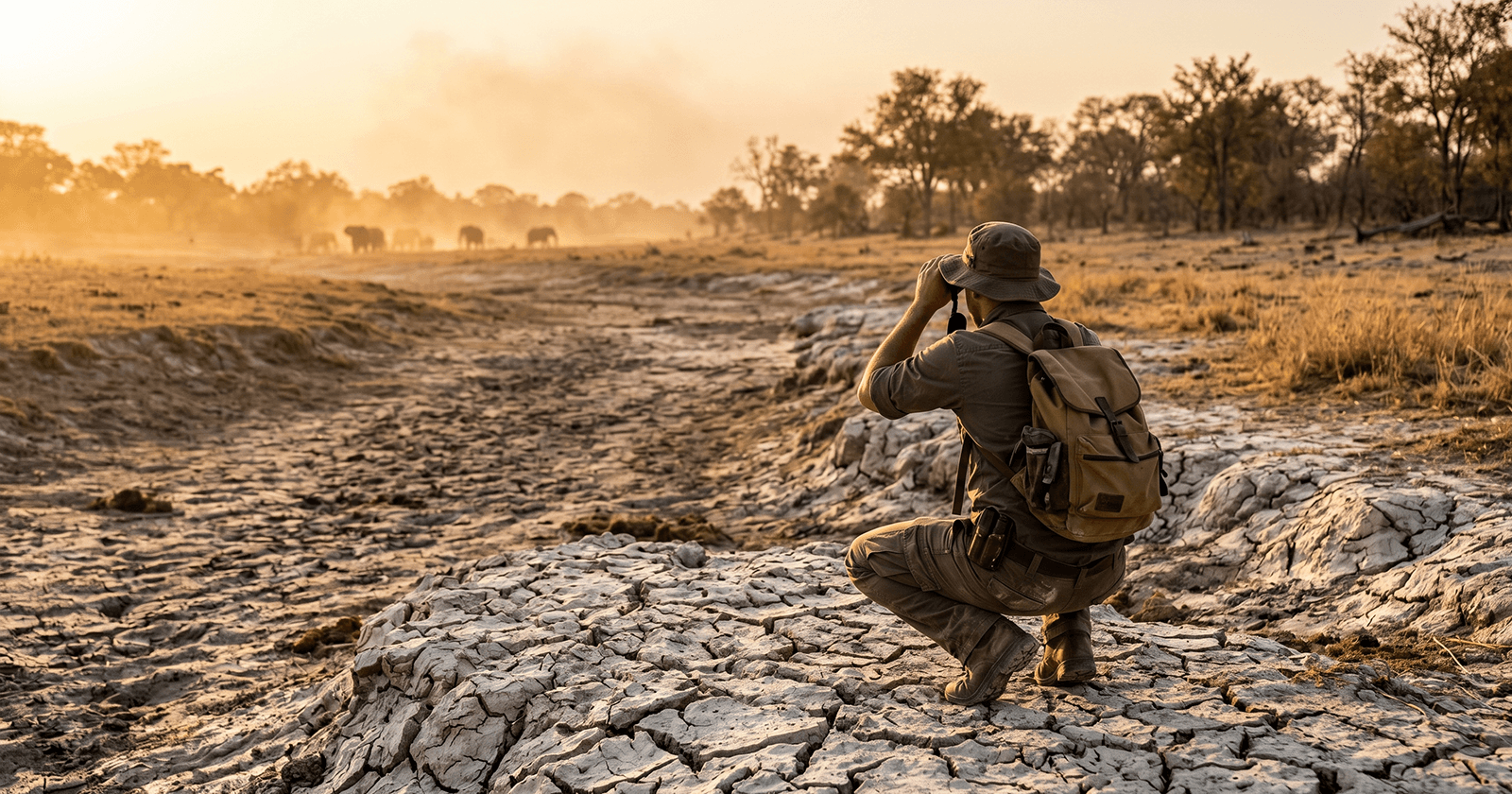
African field optics serve two distinct phases of every game drive and walking safari. The first phase is search and scan — covering ground, sweeping treelines, reading the bush for the flicker of an ear, the dull glint of a horn tip, the motionless shape that shouldn't be stationary. In this phase, field of view is the governing criterion. The wider your optical window, the more landscape you process per sweep, and the faster you locate camouflaged subjects in dense vegetation.
The second phase is stationary observation — holding on a subject once found, reading body language, identifying markings, watching a predator's behaviour without disturbing it. In this phase, contrast, edge-to-edge sharpness, and low-light transmission are the governing criteria. You need the glass to work as hard as the available light permits.
The Monarch M5 and M7 serve these phases with different emphases. Understanding which phase dominates your safari itinerary is the only question that matters before you reach for either.
The physical demands of the African environment add a third layer. Both binoculars will be subjected to red Kalahari earth suspended in 45-degree heat, cold damp air rising off the Okavango channels at first light, vibration from corrugated gravel tracks at 60 kilometres per hour, and the greasy residue of sunscreen and insect repellent transferred from gloved hands to objective lenses every time you raise the glass. Neither binocular fails in these conditions. But the M7 was engineered with several of them specifically in mind.
Nikon Monarch M5 8x42 — The Walking Safari Specialist
The Nikon Monarch M5 8x42 weighs 22.2 ounces (629 grams). Over a twelve-kilometre walking safari in South Luangwa's mopane scrub, that 1.4-ounce weight advantage over the M7 becomes tangible. Multiply it by six hours of active movement through terrain that demands constant situational awareness at a metre-by-metre scale, and the M5's design philosophy becomes clear.
The glass is genuinely excellent. ED elements eliminate the chromatic fringing that lesser binoculars produce at high-contrast edges — the white egret against a dark treeline, the movement of a buffalo tail in shadow. The dielectric high-reflective multilayer prism coating pushes light transmission into the range where early-morning and late-afternoon performance on foot is reliable. The 19.5mm eye relief is the specification that matters most to the walking safari specialist: it is long enough to provide a full field of view while wearing polarised sunglasses, which every serious foot safari traveller uses in open terrain.
The field of view is 335 feet at 1,000 yards — respectable, and sufficient for stationary observation and moderate-distance tracking. The limitation is its narrowness relative to the M7 when you are sweeping for movement in mixed woodland. The absence of a locking diopter means the fine-focus ring is susceptible to being nudged out of setting during prolonged contact with a harness or when fumbling the glass in cold pre-dawn light. For the walking safari specialist who sets their diopter once at camp and never adjusts it, this is a minor inconvenience. For the vehicle-based traveller absorbing road vibration for two hours between sightings, it becomes a functional irritant.
The M5 is the correct choice for the reader who prioritises weight-to-performance ratio above all else — the multi-day foot safari, the gorilla trek where every gram is a negotiated decision, the birding specialist who needs long eye relief through sunglasses more than they need the widest possible optical window.
A Nikon tripod adapter unlocks stable long-duration viewing for kills and nests when the M5 is paired with a carbon-fibre travel tripod, extending its utility beyond active walking use.
Nikon Monarch M7 8x42 — The Game Drive Operator
The Nikon Monarch M7 8x42 was built for the photographic vehicle safari — specifically for the Okavango Delta and open-plains environments where wide situational awareness drives the quality of every sighting.
The headline specification is the field of view: 435 feet at 1,000 yards. That is nearly 30% wider than the M5's optical window. In practical terms it means that at 300 metres — a typical game drive vehicle distance from a pride of lions in the Okavango — the M7 gives you a view 30 metres wider than the M5. That 30 metres is the difference between seeing a single lion in the frame and reading the entire pride's behaviour simultaneously. For the vehicle-based observer scanning the edge of a waterhole at dusk, this is not an incremental improvement. It is a qualitatively different experience.
The locking diopter is the other specification that game drive operators need to understand. Every binocular has a diopter ring for fine-tuning the focus between your left and right eye. On the M5, this ring turns freely. On a bumpy two-hour drive between sightings on a Botswana sand track, that ring moves. Not dramatically — but enough that the view you raise the glass to at the kill site is fractionally different from the one you calibrated at first light. The M7's locking diopter clicks into position. Once set, it stays. In a vehicle-based context where the binoculars spend more time rattling in a door pocket than around your neck, this is a meaningful engineering decision.
The exterior oil and water-repellent lens coating addresses the third challenge of the vehicle safari environment: contamination. Safari vehicles carry sunscreen, insect repellent, red dust, and the oils transferred from skin contact during six hours of active handling. The M7's treated outer lenses allow a dry microfibre cloth to clear smudges and dust residue without the risk of scratching that comes with applying pressure to uncoated glass. A quality field lens cleaning kit is still worth carrying in your day pack — coated glass is more forgiving, not bulletproof.
The M7's phase-correction coated prisms are also a meaningful upgrade over standard prism coatings. Phase correction compensates for the optical distortion introduced when light passes through a roof prism. The result is marginally sharper edge-to-edge rendering across the wider field of view — particularly visible when tracking a moving subject across the full optical window.
The weight penalty is real: 23.6 ounces (669 grams) versus the M5's 22.2 ounces. On a vehicle game drive that difference is irrelevant. On a walking safari it accumulates. The M7 is the correct choice for the reader whose safari itinerary is vehicle-based, whose vehicle regularly travels corrugated tracks, and whose primary requirement is the widest possible optical window for situational awareness in dense bush.
A binocular chest harness is the recommended carry method for both products on vehicle safaris — it keeps the glass accessible without the neck strain that a standard neck strap causes over six-hour game drives.
Nikon 16765 vs 16767: The Technical Breakdown
For readers comparing specific model numbers — 16765 is the Monarch M7 8x42 and 16767 is the Monarch M5 8x42. Both are current production models as of 2026. The following table lays out the full technical comparison against the criteria that govern African field performance.
| Specification | Nikon Monarch M5 (16767) | Nikon Monarch M7 (16765) |
|---|---|---|
| Magnification | 8x | 8x |
| Objective Lens Diameter | 42mm | 42mm |
| Field of View at 1,000 yards | 335 ft (6.4°) | 435 ft (8.3°) |
| Eye Relief | 19.5mm | 17.4mm |
| Weight | 22.2 oz (629g) | 23.6 oz (669g) |
| Prism Coating | Dielectric high-reflective multilayer | Phase-correction + dielectric |
| Locking Diopter | No | Yes |
| Oil/Water-Repellent Exterior Coating | No | Yes |
| Price Range | $280 – $330 | $450 – $490 |
| Water/Fog Resistance | Nitrogen purged, waterproof | Nitrogen purged, waterproof |
The weight difference of 1.4 ounces is meaningful only in multi-day foot safari contexts. The field of view difference of 100 feet at 1,000 yards is meaningful in every context where you are scanning for movement across open terrain. The locking diopter and oil-repellent coating are meaningful specifically in the vehicle safari environment. The eye relief advantage sits firmly with the M5 — 19.5mm versus 17.4mm — which is the specification that matters most for readers who wear prescription eyewear or polarised sunglasses in the field.
For the full technical framework on selecting optics specifically for hunting applications in Southern Africa, the Hunting Binoculars South Africa 2026 guide covers calibre-matched glass selection, ethical shooting distance optics, and plains game glassing technique in detail.
Field of View: The 100-Foot Difference That Changes Everything
The single most compelling performance differentiator between these two binoculars is the 100-foot field of view advantage the M7 holds at 1,000 yards. To understand why this matters in the field, consider the standard game drive scenario: you are 250 metres from the edge of a waterhole. Your guide has called a lion kill on the far bank. You raise the M5. You see one lion feeding. You raise the M7. You see the feeding lion, the two subadult males watching from ten metres right, and the hyena edging in from the shadow at the frame's far left.
That is not an incremental optical improvement. That is a qualitatively different intelligence picture — the kind that tells a professional hunter or wildlife photographer whether the approach is safe to continue, whether the photographic composition has three subjects instead of one, whether the dynamics around that kill are about to change. The difference between seeing a whole pride and seeing a fragment of it is a field decision, not an aesthetic preference.
At 8x magnification, heat shimmer becomes the atmospheric ceiling — not the glass itself. Across open ecosystems like the Serengeti, Etosha, or the open Chobe floodplain, heat shimmer degrades resolution at ranges above 400 metres from approximately 10:30 AM under full sun. This ceiling applies equally to both binoculars. The M7's optical superiority is fully expressed during the productive shooting windows — the first two hours after dawn and the final ninety minutes before dark — when atmospheric stability allows the glass to perform at its specification limit. It is during these windows that the wider FOV and phase-corrected prisms deliver their maximum return.
Order the Nikon Monarch M7 on Amazon
Performance Ceiling: What Neither Binocular Can Beat
Every binoculars buyer needs to understand the external ceilings that limit both products equally — conditions that reduce optical performance regardless of glass quality, prism coatings, or price point.
The first ceiling is heat shimmer. At 8x magnification across open African terrain, atmospheric turbulence above heated ground creates visible shimmer that degrades resolution at ranges above roughly 300 to 400 metres from around mid-morning onward. Neither the M5 nor the M7 overcomes this. The mitigation is timing — both binoculars perform at their specification ceiling during the cool, stable air of the first and last hours of daylight.
The second ceiling is dust accumulation on the objective lens. Fine particulate dust — the kind that coats every surface within minutes of arriving in the Kalahari or Etosha — reduces internal contrast by sitting on the glass surface between the observer and the subject. The M7's oil-repellent exterior coating makes dry-cloth removal safer and more effective than on the M5's uncoated objectives. But both binoculars require regular lens hygiene in high-dust environments. A dedicated field lens cleaning kit with a carbon-brush blower and optical-grade microfibre cloths is essential kit for either product on a Southern African safari.
The third ceiling is magnification itself. At 8x, both binoculars require stable hands for sharp resolution at maximum range. On a game drive vehicle stopped in position, this is not an issue. Walking, with heart rate elevated after a fast approach through thick bush, the image shakes. A Nikon tripod adapter provides the stable mount that converts either binocular into a precision observation tool for prolonged stationary use.
The Verdict: Which Binocular Earns Its Place in the Bakkie
The Nikon Monarch M7 is the stronger safari binocular for the majority of African travellers. The wider field of view, locking diopter, and oil-repellent lens coating address the three specific challenges of vehicle-based game drive use — situational awareness across open terrain, optical stability on corrugated tracks, and lens hygiene in high-dust environments. The $150 price premium over the M5 is a genuine field investment, not a marketing premium.
The M7 buyer is on a photographic vehicle safari in the Okavango Delta. Their primary measure of success is rapid acquisition of moving subjects — a hunting pack in full pursuit, a heron landing at 200 metres, a leopard breaking cover at the treeline — and stable optical performance between sightings on rough sand tracks. The M7 is the correct choice.
The Nikon Monarch M5 is the correct choice for the reader heading into the South Luangwa on a multi-day walking safari. The weight-to-performance ratio is exceptional at this price point, the ED glass performs at the level of binoculars costing significantly more, and the 19.5mm eye relief makes it the most comfortable 8x42 available for prescription eyeglass or sunglass wearers in the field. For the walking safari specialist, the M7's locking diopter and wider FOV are secondary to the fatigue accumulation of carrying extra weight across twelve kilometres of predator territory in 38-degree heat.
Both products have a direct purchase path below. Buy the one that matches your deployment context.
Buy the Nikon Monarch M7 on Amazon
Buy the Nikon Monarch M5 on Amazon
People Also Ask
Is the Nikon Monarch M7 worth the extra money over the M5?
For vehicle-based game drive safaris, yes. The M7's wider field of view (435 ft vs 335 ft at 1,000 yards), locking diopter, and oil-repellent exterior coating address three specific challenges of the African field environment that the M5 does not. For walking safari specialists prioritising weight and eye relief over optical width, the M5 delivers equivalent optical performance at $150 less.
What is the difference between the Nikon Monarch 5 and Monarch M5?
The Monarch M5 (model 16767) is a redesigned successor to the earlier Monarch 5 line. The M5 introduced updated ED glass formulation, higher-reflectivity dielectric prism coatings, and a revised body design. The two are not the same product and the M5 represents a meaningful optical upgrade over the original Monarch 5.
Which Nikon binoculars are best for spotting leopards?
The M7 is the stronger choice for leopard spotting specifically because of its wider field of view. Leopards are most commonly found by scanning the edges of dense vegetation — river thickets, drainage lines, rocky koppies — where movement at the periphery of the visual field is the primary detection cue. The M7's 8.3° angle of view provides a meaningfully wider scanning window than the M5's 6.4°.
Are the Nikon Monarch M7 binoculars waterproof?
Yes. The M7 is nitrogen-purged and fully waterproof. Nitrogen purging replaces the internal air with inert gas, eliminating the moisture that causes internal fogging when glass surfaces change temperature rapidly — for example, when raising cold pre-dawn binoculars from a camp bag to the warm air of a bush clearing at first light.
Does the Nikon Monarch M5 come with a tripod adapter?
No. The Nikon Monarch M5 and M7 both include a 1/4"-20 threaded socket under the front bridge cap for tripod adapter attachment, but neither product ships with the adapter included. The compatible Nikon tripod adapter (model 7070/821) is available separately on Amazon and is recommended for any prolonged stationary observation — waterhole vigils, kill monitoring, or nest watching — where handheld stability at maximum range is limiting the glass's performance.
Krantz Outdoors is a specialist pan-African safari research publication. Our editorial team aggregates field intelligence from professional trackers, wildlife photographers, and conservation scientists to deliver technically verified safari briefings.
This article is compiled from manufacturer specifications, verified field reports, and specialist optics research. Krantz Outdoors conducts independent editorial review of all content.
This article contains affiliate links to Amazon. If you purchase through our links, Krantz Outdoors may earn a small commission at no additional cost to you. We only recommend products we genuinely believe in.
Wild by Nature. Africa by Choice.
Read our Privacy Policy and Terms & Conditions