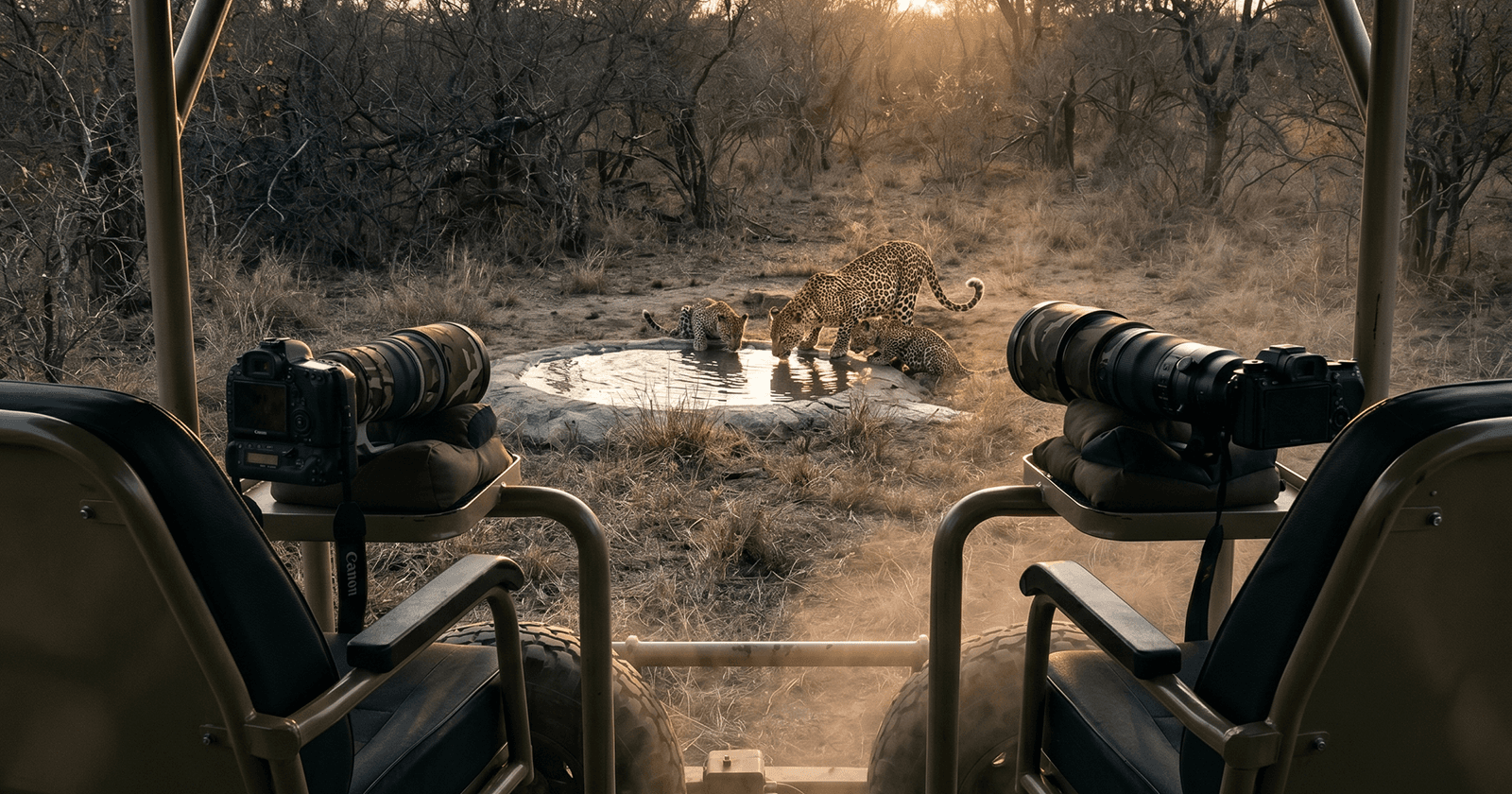

5 Day MalaMala Safari Review — Big Five Game Reserve in the Sabi Sands
Inside Africa's Most Consistent Big Five Reserve — and the Tracking Intelligence That Makes It Work
Wild by Nature. Africa by Choice.
→ Secure Your MalaMala Safari Here
There are safari experiences, and then there is MalaMala. The distinction is not marketing — it is documented. MalaMala Game Reserve holds the highest recorded Big Five sighting frequency of any private reserve in southern Africa, and has maintained that record across decades of operation. Every serious safari traveller eventually asks the same question: is that reputation actually earned, or is it the accumulated weight of a brand that has been marketing itself since 1927? The answer is yes — it is earned. And the mechanism behind it is not luck, not location alone, and not the quality of the lodge rooms. It is tracking intelligence. It is the Sand River system. It is an unfenced border with Kruger National Park that doubles the effective wildlife territory overnight. And it is a guide corps that carries multi-decade individual animal knowledge that no other reserve in the Sabi Sands can replicate at the same depth. This 5-day package, available through Safari.com, is your entry point into all of it.
Q: What does the 5 Day MalaMala Safari package include?
A: The 5 Day MalaMala Safari package includes return flights from Johannesburg to Skukuza Airport, road transfer from Skukuza to MalaMala Camp, four nights accommodation at MalaMala Camp, all meals and beverages throughout, two daily game drives at dawn and dusk in open safari vehicles, bush walks with expert guides and trackers, and all park fees and conservation levies. The package is fully inclusive and operates on MalaMala's private 37,065-acre traversing area sharing an unfenced border with Kruger National Park in the Sabi Sands Game Reserve.
→ Secure Your MalaMala Safari Here
The MalaMala Method: Why Consistency Is Not Luck
MalaMala's Big Five sighting record is the first thing every review mentions and the last thing any review properly explains. Understanding the mechanism behind it is the most useful intelligence a traveller can carry into a booking decision — because it reveals exactly what you are paying for and why no other Sabi Sands property delivers the same result at the same consistency.
The Unfenced Border Advantage
MalaMala shares an open, unfenced boundary with Kruger National Park. This is not a minor geographical detail — it is the foundational operational advantage of the reserve. Kruger covers nearly two million hectares of protected wilderness. MalaMala's 37,065 acres of private traversing land effectively functions as a high-density, low-vehicle wildlife corridor connecting to that vast protected area. Animals move freely across the boundary in both directions — following seasonal grazing, water availability, and territorial pressure — which means MalaMala's wildlife population is not confined to its own acreage. It is supported by the full ecological weight of one of Africa's largest national parks.
The practical result: wildlife density on the MalaMala traversing area consistently exceeds what the reserve's own land area would naturally support. Lion prides that range across the Kruger boundary return to the Sand River corridor. Elephant herds that feed in the Kruger woodlands water at MalaMala's riverine frontage. Leopard territories that extend into the national park concentrate their activity in the private reserve's riverine drainage lines. The border is not a boundary — it is a wildlife pipeline.
The Sand River System
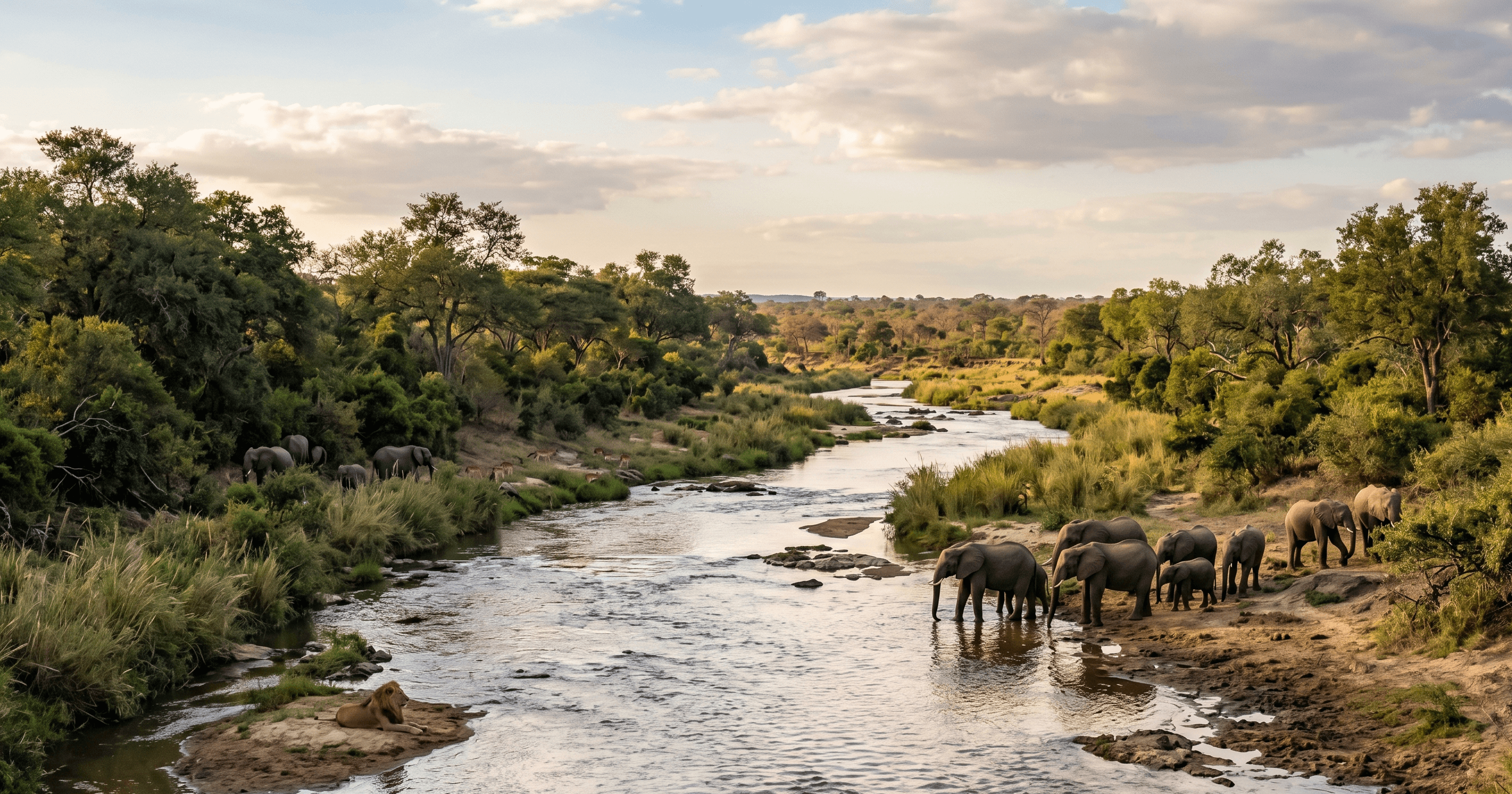
The Sand River runs through the heart of the MalaMala traversing area and is the single most important ecological feature of the reserve. During the dry season months from May through October, the Sand River becomes the primary water source for a wildlife population that includes all Big Five species, wild dog, cheetah, hyena, and over 350 recorded bird species.
Water concentration mechanics work the same way in the Sabi Sands as they do in every southern African ecosystem — when surface water contracts to reliable points, wildlife movement becomes predictable. A tracker with Sand River knowledge does not search for animals. He identifies which section of the river still holds water, reads the tracks in the sandy substrate to determine which species have been drinking and at what hour, and positions the vehicle at the approach corridor before the animals arrive. For context on how the same river system influences photographic safari strategy in the western sector of the Sabi Sands, our Leopard Hills Safari Review details the Sand River's tactical role from a different operational position within the same ecosystem.
The Individual Animal Knowledge
This is the MalaMala advantage that is hardest to quantify and most commercially significant. MalaMala's senior guides carry individual animal knowledge accumulated across decades of daily observation on the same traversing area. They know individual leopard by name — their territories, their cubs, their favoured kopjes, their hunting patterns. They know which lion pride uses which drainage line at which time of year. They know the elephant matriarch that leads her herd to the Sand River at 07h15 every dry-season morning.
This depth of individual knowledge is not replicable at a property that has been operating for five years. It is the compound product of consistent observation over decades by a guide corps that has largely stayed on the same reserve throughout their careers. It is why MalaMala's sighting consistency is not luck — it is institutional memory applied to daily field intelligence.
MalaMala Camp: The Original Flagship
MalaMala Camp is the original flagship lodge of the reserve — the oldest private game lodge in the Sabi Sands, and one that has deliberately resisted the pressure to reinvent itself in the image of newer, more architecturally aggressive properties. What it offers instead is something genuinely rarer in the modern luxury safari market: authenticity earned through longevity.
The rooms are spacious, air-conditioned, and oriented directly onto the bush — designed to put the landscape front and centre rather than competing with it architecturally. The interiors are classic safari in the truest sense: warm tones, natural materials, and a design philosophy that prioritises immersion over statement.
Dining at MalaMala operates as a genuine field experience rather than a restaurant performance. Dinners are served in a reed-enclosed boma beneath an ancient jackalberry tree, with log fires burning under a clear Lowveld sky. On suitable nights the setting moves to the safari deck overlooking the Sand River — candlelit, unhurried, and oriented toward the darkness of the bush beyond the riverbank. The sounds of the African night are not background atmosphere — they are the point.
The Game Drives: Dawn, Dusk, and the Tracking Method
Two game drives daily — dawn and dusk — on a fully private traversing area of 37,065 acres. The drives operate in open safari vehicles with experienced guides and trackers working in tandem: the guide managing the vehicle and the guest experience, the tracker reading the landscape from the vehicle's elevated tracking seat at the front.
The MalaMala tracking methodology is built on three simultaneous information streams that experienced field operators run concurrently throughout every drive:
Track Reading: The sandy substrate of the Sand River and its surrounding drainage lines holds tracks with exceptional clarity. A lion pride that crossed the river at 03h00 leaves a readable record in the sand — direction of travel, number of animals, approximate time based on track degradation and dew coverage. A leopard that dragged an impala into a marula tree overnight leaves a scent trail, scratch marks on the bark, and the hanging carcass that anchors the animal to a specific tree for the next 48 hours. These are not signs that require interpretation — they are a field report written in the landscape.
Radio Intelligence: MalaMala's guide network operates a coordinated radio communication system across the full traversing area. When one vehicle locates a significant sighting — a leopard on a kill, a lion pride with cubs, a rhino in open ground — that intelligence is shared across the network. A private reserve with the traversing scale of MalaMala operates this system more effectively than smaller properties simply because the information network is larger and the vehicle coverage of the area is more comprehensive.
Behavioural Reading: The most sophisticated component of the MalaMala tracking method is the reading of secondary behavioural signals — the alarm calls of oxpeckers indicating a buffalo moving through dense bush, the nervous behaviour of impala ewes signalling a predator within 200 metres, the flight direction of vultures indicating a kill site three kilometres across the plain. An experienced MalaMala guide integrates these signals in real time, triangulating position and species before the vehicle leaves the road.
Bush walks are available for guests who want to experience the landscape at ground level — learning to read tracks, identify plants, and understand the ecological relationships that drive the Big Five dynamics above. A walking safari in the Sabi Sands operates under a fundamentally different tactical framework from a vehicle drive — as our Victoria Falls Safari Elephant Camp explores in the context of the Wild Horizons walking trail methodology on the Zambezi concession.
The Big Five at MalaMala: What to Expect
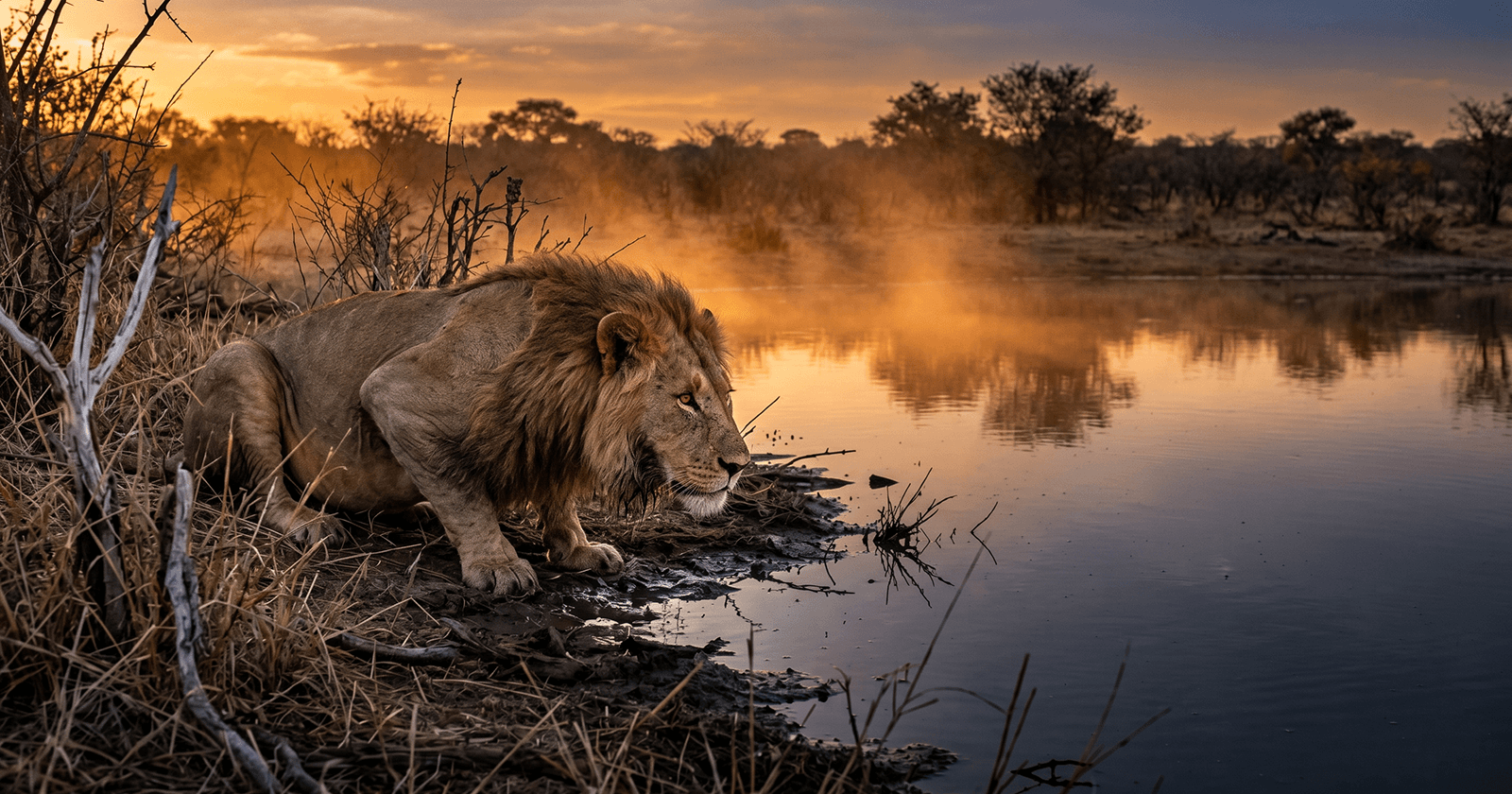
Lion: Multiple resident prides hold territory across the MalaMala traversing area. Lion sightings are among the most consistent in the Sabi Sands — the open plains and riverine drainage lines provide both the hunting terrain and the resting cover that lion require, and the Sand River corridor concentrates prey species that anchor pride movement to predictable corridors.
Leopard: MalaMala is arguably the finest leopard viewing destination in Africa. The combination of the Sand River riparian forest, the rocky drainage lines, and the decades of individual leopard knowledge carried by the guide corps produces a sighting consistency that no other southern African reserve matches at scale. Individual leopards are known, tracked, and located with a reliability that feels improbable until you understand the institutional knowledge behind it.
Elephant: The unfenced Kruger border means elephant herds that range across hundreds of kilometres of protected wilderness regularly move through the MalaMala traversing area. Sightings are frequent and often involve large family herds rather than solitary bulls — the Sand River provides the water source that draws matriarch-led groups into predictable daily movement patterns.
Buffalo: Large buffalo herds are a consistent feature of the MalaMala landscape, particularly during the dry season months when the Sand River concentrates both the herds and the lion prides that follow them. Buffalo and lion interactions at the river are among the most dramatic predator-prey dynamics in the Sabi Sands.
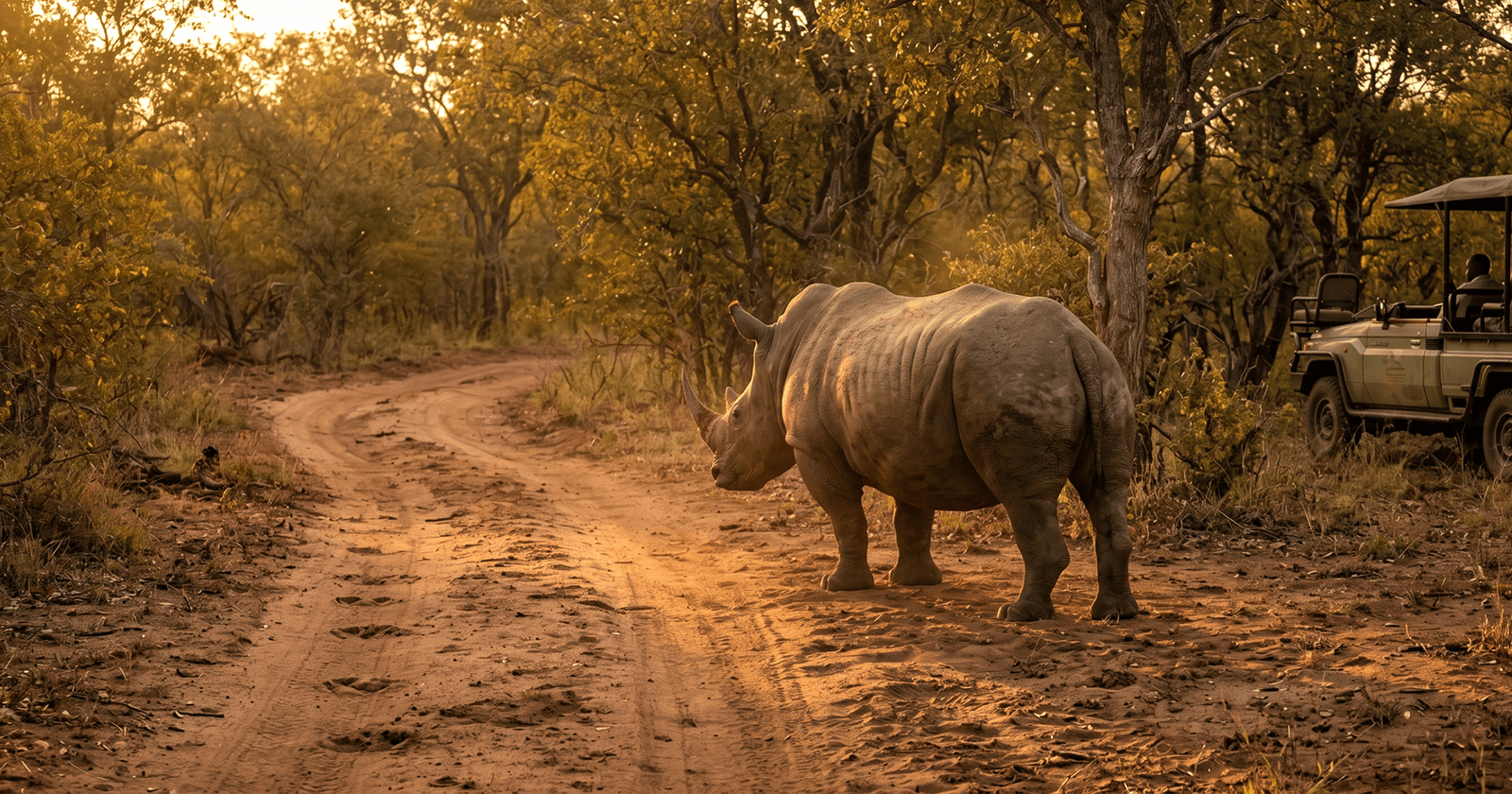
Rhino: Both white and black rhino are present on the MalaMala traversing area. White rhino sightings are more frequent — the open grassland sections of the reserve provide the grazing habitat that white rhino prefer. Black rhino sightings are less predictable but the reserve's size and the guide network's intelligence system make encounters possible on most multi-day stays.
Best Time to Visit: The Sabi Sands Seasonal Guide
Dry Season — May through October The operational sweet spot for Big Five sighting frequency. Vegetation thins progressively through the dry season as the Sand River drops and waterholes become critical gathering points for wildlife. By August and September the bush is at its most open — maximum visibility, maximum wildlife concentration at water, and the most dramatic predator-prey dynamics of the year as lion and leopard exploit the vulnerability of dehydrated prey. This is peak season and the window that delivers MalaMala's most consistent Big Five sighting performance.
Green Season — November through April A fundamentally different Sabi Sands experience. The Lowveld transforms with the first November rains — the landscape greens rapidly, migratory bird species arrive from the north, and the lodge operates at reduced occupancy. Leopard cubs born in the dry season are becoming mobile and visible. Lion prides with young cubs are active and easily located. The photographic quality of green-season light — dramatic storm clouds, lush vegetation backgrounds, and the golden quality of post-rain afternoon sun — is superior to dry-season conditions for environmental portraiture. Game viewing is more challenging due to vegetation density but the rewards for patient observers are significant.
Shoulder Months — April and October The transition months deliver a hybrid experience — residual dry-season wildlife concentration in April as the rains have not yet broken, and the first green flush arriving in October as the summer build begins. Both months offer strong game viewing with slightly reduced visitor numbers compared to peak dry season. October in particular delivers the pre-rain tension that experienced field operators describe as the most electrically alive the bush feels all year.
People Also Ask: Everything You Need to Know Before You Book
Is MalaMala worth it compared to other Sabi Sands lodges? MalaMala's competitive position in the Sabi Sands is built on three structural advantages that newer properties cannot replicate: the unfenced Kruger border that doubles effective wildlife territory, the Sand River system that anchors Big Five movement through predictable corridors, and the multi-decade individual animal knowledge carried by a guide corps with exceptional institutional longevity. For travellers whose primary objective is maximum Big Five sighting consistency on a fixed itinerary, MalaMala's documented sighting record makes it the benchmark against which every other Sabi Sands property is measured.
What is the best time of year to visit MalaMala? May through October delivers the highest Big Five sighting frequency as vegetation thins and wildlife concentrates around the Sand River and remaining waterholes. August and September represent the peak of dry-season wildlife concentration. October adds pre-rain atmospheric drama and heightened predator activity. November through April delivers superior photographic light conditions, migratory bird species, and reduced camp occupancy — a quieter, more intimate experience with different but equally rewarding game viewing dynamics.
How do you get to MalaMala Game Reserve? The package includes return flights from OR Tambo International Airport in Johannesburg to Skukuza Airport, followed by a road transfer from Skukuza to MalaMala Camp. Total transfer time from Skukuza is approximately 45 minutes. International travellers connect through OR Tambo on most major routing options from Europe, North America, and the rest of Africa. Safari.com manages all flight and transfer logistics as part of the fully inclusive package.
What wildlife can you see at MalaMala beyond the Big Five? The MalaMala traversing area supports wild dog, cheetah, hyena, jackal, and over 350 recorded bird species in addition to the Big Five. The Sand River riparian forest holds a particularly rich bird list including African fish eagle, giant kingfisher, and a broad range of woodland species. Wild dog sightings are less predictable than Big Five encounters but the pack that ranges across the MalaMala-Kruger border is regularly located through the reserve's radio intelligence network.
Are bush walks included in the MalaMala package? Yes. Bush walks with expert guides and trackers are included in the package alongside the twice-daily vehicle game drives. Walking safaris in the Sabi Sands operate under a different tactical framework from vehicle drives — smaller groups, slower pace, and a focus on the ecological detail that vehicle drives move past. The ground-level perspective reveals track reading, plant identification, and the smaller ecological relationships that underpin the Big Five dynamics visible from the vehicle. It is a complementary experience rather than a substitute for the game drive programme.
Value Architecture: What the Package Delivers
| Component | Self-Arranged Visit | MalaMala 5 Day Package |
|---|---|---|
| Flights | Arranged separately | Return JHB — Skukuza included |
| Transfers | Arranged separately | Road transfer included |
| Accommodation | Nightly rate only | 4 nights fully inclusive |
| Game Drives | Park fee additional | Twice daily included |
| Bush Walks | Separate booking | Included |
| Meals and Beverages | Restaurant cost additional | Fully inclusive throughout |
| Conservation Levies | Separate payment | All included |
The fully inclusive architecture removes every logistical variable from the MalaMala experience. From OR Tambo arrival to departure transfer, the operational focus remains entirely on the wildlife rather than the friction of daily cost management. For a reserve where the guide's undivided attention and the tracker's full operational focus are the primary product, removing that friction is not a convenience — it is a performance condition.
This package is bookable through Safari.com — Africa's Leading Safari Company, recognised at the World Travel Awards in both 2024 and 2025. Their safari specialists respond within 24 hours and can extend the stay, upgrade the accommodation tier, or connect this package to a broader southern Africa itinerary including Botswana, Zimbabwe, or the Cape.
→ Deploy to MalaMala: Finalize Booking via Safari.com
Krantz Outdoors is a specialist pan-African safari research publication. Our editorial team aggregates field intelligence from professional trackers, wildlife photographers, and conservation scientists to deliver technically verified safari briefings.
This article is compiled from operator specifications, verified field reports, and specialist photography research. Krantz Outdoors conducts independent editorial review of all promotional content.
Affiliate disclosure: This article contains affiliate links. If you book through our Safari.com, Krantz Outdoors may earn a small commission at no additional cost to you. We only recommend experiences we genuinely believe in.
Wild by Nature. Africa by Choice.
📄 Read our Privacy Policy and Terms & Conditions